


Israel Election Turnout Hits Highest Level in Years; Netanyahu Leads Without Majority
Error: Contact form not found.

 by Debbie Weiss


A bride and groom cast their vote in a polling station before their evening wedding on the day of Israel’s national election, in Herzliya, Israel, Oct. 27, 2026. Photo: REUTERS/Itay Cohen
Israeli voters turned out in their highest numbers in years on Tuesday, as Prime Minister Benjamin Netanyahu faced a challenge to his 19-year rule in the country’s first general election since the Oct. 7, 2023, Hamas attacks.
By 10 pm, an astounding 77.7% of eligible voters — or 5,695,682 Israelis — had cast their ballots, the highest turnout recorded since 1999, according to the Central Elections Committee.
Long lines formed at polling stations across the country, prompting election officials to issue instructions aimed at speeding up the process.
The election pits Netanyahu, Israel’s longest-serving prime minister with nearly two decades in power over nonconsecutive terms, against Gadi Eisenkot, a former Israel Defense Forces chief of staff whose centrist Yashar party led Netanyahu’s Likud in several final opinion polls. Neither Netanyahu’s right-wing and ultra-Orthodox coalition nor the principal opposition parties were projected to secure the 61-seat majority needed to form a government in the 120-seat Knesset.
Those projections appeared to be holding as of Wednesday morning. With 77.6% of the votes counted, Netanyahu’s bloc held 54 seats, and the Eisenkot-led opposition bloc had 49 seats. Likud led as a stand-alone party with 27 seats, followed by Yashar’s 22 seats.
If neither bloc reaches a 61-seat majority after the votes are counted, then leaders may need to seek the support of smaller parties outside their coalition in order to form the next government.
FINAL CAMPAIGN PITCHES
Netanyahu, who voted in Jerusalem alongside his wife, Sara, appealed urgently to his supporters as reports emerged of unusually high turnout among Arab voters.
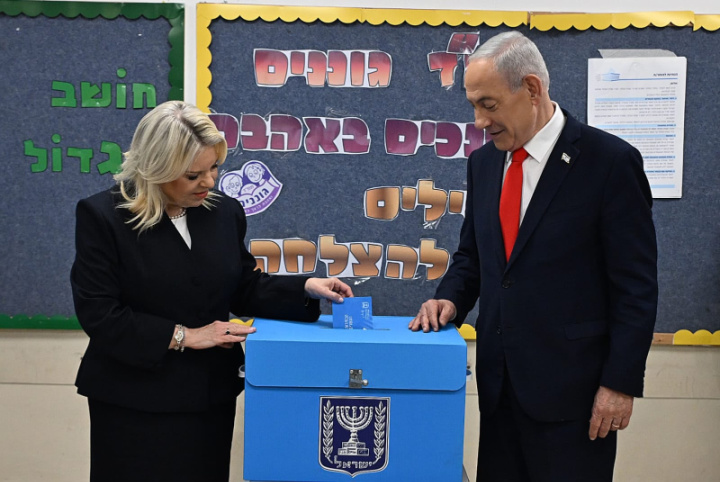
Israeli Prime Minister Benjamin Netanyahu, right, votes with his wife, Sara, in Israel’s parliamentary elections, in Jerusalem, Oct. 27, 2026. Photo: Israeli Prime Minister’s Office (PMO)
In a video circulated on Tuesday, Netanyahu accused political opponents of attempting to manipulate the election, citing the arrests of three men in the Negev suspected of trying to purchase votes for the Islamist Ra’am party. Investigators said they found envelopes containing tens of thousands of shekels and ballot slips during searches of the suspects’ homes.
“They are trying to steal our election,” he declared, warning his supporters that Arab voters in southern Israel were turning out in particularly large numbers.
“You have to go out and vote. You, too, have to run to the polling stations,” Netanyahu said. “No beach, no barbecue. Everyone go out and vote Likud.”
“The future of our Jewish state is at stake,” he added.
Turnout among Arab voters stood at 53.2% in the 2022 election, but polling experts have estimated that it could approach 70% this year. Jewish and Arab activists had spent the final days of the campaign encouraging residents to vote, particularly younger people, whose participation has historically been low.
At a polling station in Jaffa, the mixed Jewish-Arab area of Tel Aviv, voters cast their ballots.
“I’ve never voted before because I always felt like it makes no difference. But this time all my family are going out to vote for the first time,” one visibly Muslim woman, who spoke on condition of anonymity, told The Algemeiner. She added that her vote was going to the Joint List, an alliance of three predominantly Arab parties headed by Yousef Jabareen.
Netanyahu has repeatedly made Arab voter turnout a campaign issue, presenting the election as a choice between his right-wing coalition and a government dependent on Arab lawmakers. His final campaign advertisements carried the slogan “Right or Palestine.”
According to the latest vote count, the Arab parties won 17 seats in parliament.
Eisenkot, meanwhile, began election day in Kibbutz Nir Oz, one of the communities devastated during the Oct. 7 attacks, accompanied by former hostage Gadi Mozes, who was abducted from the kibbutz by Hamas.
Eisenkot, whose son and nephew were killed fighting in Gaza, has made accountability for the Oct. 7 security failures central to his campaign. He has pledged to establish a state commission of inquiry into the attacks and to dismantle Hamas’s military and governing capabilities in Gaza within 18 months of assuming office. On his way to voting in Herzliya, Eisenkot visited his son’s grave.

Gadi Eisenkot, a former Israel Defense Forces chief of staff and head of the centrist Yashar party, and his wife, Chana, visit the grave of their late son, Gal Meir, at the military cemetery in Herzliya, Oct. 27, 2026. Photo: Yashar Campaign
He has also ruled out serving under Netanyahu, including in a rotating premiership arrangement.
THE FIRST POST-OCT. 7 VOTE
The election began with a ceremony at Tel Aviv’s Hostages Square, where relatives of those murdered or abducted on Oct. 7 observed a minute of silence at 6:29 am, the time the Hamas-led assault began three years earlier.
Einav Zangauker, whose son Matan survived Hamas captivity and who has been an outspoken critic of Netanyahu’s government, urged Israelis to remember the victims when voting.
“Remember them at the ballot box. That’s what today’s election is about,” she said. “Go out and vote so that such a failure never happens again, so that we know what happened and who is responsible, and so that we can finally begin to repair and rebuild.”
Netanyahu’s government has resisted establishing a conventional state commission led by judges appointed by the Supreme Court president, favoring an alternative investigative mechanism.
Other political leaders also used their appearances at polling stations to urge supporters to vote.
Former Prime Minister Naftali Bennett, who heads the opposition Together alliance with former Prime Minister Yair Lapid, drew a comparison between the civilian mobilization during the Oct. 7 attacks and Tuesday’s vote.
“We are a nation of lions who went out to save the country on Oct. 7 when there was no government,” Bennett said after voting in Ra’anana. “Today, on Oct. 27, this nation of lions is going out to save the country again.”
National Security Minister Itamar Ben-Gvir, the leader of the far-right Otzma Yehudit party, struck a different note after voting in Kiryat Arba, warning that an opposition victory would produce a government dependent on Ra’am leader Mansour Abbas.
“Netanyahu will be prime minister, and we will carry the flag of the right in that government,” Ben-Gvir said.
Former Defense Minister Avigdor Liberman, leader of the secular nationalist Yisrael Beiteinu party, called for an end to what he described as Netanyahu’s dependence on ultra-Orthodox parties.
“The era of Netanyahu and ultra-Orthodox rule must come to an end,” he said, reiterating his support for mandatory military service and a state commission of inquiry in the failures that lead to Oct. 7.
Election day was also marked by several security incidents and allegations of voting irregularities.
Police detained a man carrying a knife near Yair Golan, leader of the left-wing Democrats party and a former deputy IDF chief of staff, during an election campaign appearance in Tel Aviv.
Golan’s party initially described the incident as a suspected attempt to stab him, saying the man had approached in a threatening manner before a knife fell from his clothing.
The suspect, a Jerusalem resident in his 20s, was taken for questioning.
COALITION-BUILDING WITHOUT A MAJORITY
With more than 7.3 million Israelis eligible to vote, the outcome could hinge on the participation of Arab voters and supporters of smaller parties, particularly those competing to cross the 3.25% electoral threshold required to enter parliament.
Although the final polls published Friday by Channels 12 and 13 and Kan generally placed Eisenkot’s party ahead of Likud, most showed neither political camp winning an outright majority. Channel 14, by contrast, projected enough seats for Netanyahu’s bloc to remain in power.
Even a clear lead in seats would not necessarily settle who becomes prime minister. Under Israel’s parliamentary system, voters elect parties rather than a leader directly, and the president subsequently assigns the task of forming a government to the lawmaker considered most capable of assembling sufficient parliamentary support.
If neither bloc can secure a workable majority, the next government could depend on support or abstentions from parties outside the coalition, including the Arab parties, although Eisenkot has ruled out including them in his government under their current positions.
President Isaac Herzog will consult party leaders after the results are finalized before selecting a candidate to form a government. The candidate initially receives 28 days to negotiate a coalition, with a possible 14-day extension. If those efforts fail, other candidates could be given the opportunity, and prolonged deadlock could ultimately lead to another election.
Netanyahu would remain in office until a new government is sworn in, even if his opponents win more parliamentary seats.
Israeli television networks are scheduled to release their exit polls when voting ends at 10 pm Tuesday. Official results are due by Nov. 4, although coalition negotiations could continue for weeks afterward.


