




Your Israeli Election Primer: The Issues, What to Watch for Before and on Election Night
Error: Contact form not found.

 by Uriel Zehavi


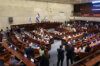
Israeli politicians react following a vote to dissolve the Knesset, Israel’s parliament, before the end of its term, at the Knesset, in Jerusalem, May 20, 2026. Photo: REUTERS/Ronen Zvulun
In Part One of this article yesterday, I summarized all the parties running in this year’s Israeli elections, what their platforms are, and the coalition numbers to get to the majority number of 61. In this article, I’ll discuss the issues at stake, what happens after the vote, and what to watch for on election night.
What the election is about
The Israel Democracy Institute’s August survey asked voters what would matter most to their vote. The economy and cost of living came first at 18 percent, then security at 17.7, the party leader at 13.9, and religion and state at 12.6. Among Jewish voters, 11.4 percent named conscription. For Arab voters, crime in their own towns came first by a distance, at 31.5 percent. And 68 percent of Jewish respondents said Oct. 7 itself is central to how they’ll vote.
The draft. In June 2024 the High Court ruled unanimously that the state has to draft yeshiva students and stop funding the yeshivas of students who aren’t exempt. This July the Knesset passed, 58 to 54, a temporary law freezing arrests of students who don’t report. On Sept. 3 a nine-justice panel struck it down, which leaves no draft law on the books. In IDI’s July numbers, 67 percent opposed the freeze. Meanwhile the cabinet extended emergency call-ups to Nov. 30 for up to 200,000 reservists.
The Oct. 7 inquiry. The government’s bill would create a six-member panel appointed by a two-thirds Knesset majority, split three and three between coalition and opposition if they can’t agree. It passed a first reading 59 to 0 in July with the opposition boycotting, then ran out of time. The opposition wants a statutory state commission, whose members are chosen by the president of the High Court. The court has given the government until Jan. 15 to answer the petitions demanding one. The polls lean toward a state commission, and how far depends on how you ask. INSS found 75 percent support, including 52 percent of coalition voters. IDI, offering several options, found 55 percent preferring one and support down about 10 points in a year.
Security. In Gaza, the Board of Peace’s envoy, Nickolay Mladenov, published a 15-point roadmap at the end of July tying Israeli withdrawal to Hamas giving up its weapons. Prime Minister Netanyahu told his cabinet Israel won’t pull back before full disarmament. In the north, a framework signed in Washington in June ties Israeli redeployment to verified disarmament in southern Lebanon, and Hezbollah rejects it. On Iran, President Trump said in September the war will end “immediately after the election.” He meant his own, on Nov. 3.
The courts. In July the Knesset passed a law, 65 to 51, making the attorney general’s legal opinions non-binding on the government. IDI found 55 percent opposed and 32 percent in favor. Petitions over that law, the judicial-selection law, and the inquiry are all waiting at the High Court.
The economy is the strange one. The numbers are mostly good and voters still put it first. Inflation was 1.5 percent in August, and the Bank of Israel has cut rates three times running, to 3.25 percent. Gasoline hit a record NIS 8.27 a liter on Oct. 1.
The world is waiting too
Some of the pressure from abroad is waiting on this vote. On Sept. 29 the US Senate voted down, 47 to 51, a motion to force Chris Van Hollen (D-MD)’s resolution demanding a State Department human-rights report on Israel out of committee. Every Democrat but John Fetterman (D-PA) voted for it, and so did Rand Paul (R-KY). A similar Bernie Sanders (I-VT) measure in January 2024 drew 11 votes. Within days, 43 House Democrats were behind H.R. 10642, mandatory sanctions tied to building in Judea and Samaria. In Europe, Portugal’s foreign minister said in September that new EU measures before Israel votes are unlikely, because Germany and Czechia want to wait. A senior European diplomat told Ynet what comes next: “The day after the elections they will rush to do so.”
After the vote
Official results come out by Nov. 4, and the new Knesset is sworn in within two weeks of election day. President Herzog then meets every party, hears whom each one recommends, and within seven days of the results asks one member to try to form a government. The law doesn’t say it has to be the leader of the biggest party, and it hasn’t always been. In 2009, Kadima won 28 seats to Likud’s 27, and President Shimon Peres gave the mandate to Netanyahu. Whoever gets it has 28 days, plus up to 14 more. Run every deadline to the limit and the first try ends around Dec. 9, or Dec. 23 with the extension. If that fails, a second member gets 28. If that fails too, any 61 Knesset members can put a name forward in writing. If nobody gets there, Israel votes again. It’s all in Basic Law: The Government.
Last time it took from Nov. 1 to Dec. 29 to swear in a government, and that was a year when one side had 64.
What to watch on election night
The threshold. Watch Amcha Yisrael, the Reservists, Blue and White, and anyone polling at four or five seats. Each list that misses moves the whole board.
Turnout. It was 70.6 percent in 2022. Arab turnout was 53.2 percent that year, up from 44.6 in 2021. Hadash, Ta’al, and Balad split before that vote, and this time they’re running together again.
The Haredi parties’ recommendation. If they tell Herzog nobody, the mandate gets a lot harder to hand out.
When the exit polls come in at 4 pm Eastern on Oct. 27 — polls close at 10 pm in Israel — skip the headline about who “won.” Count to 61.
Uriel Zehavi is Managing Director of the Mitzpe Institute (mitzpe.org) and writes the Israel Brief (israelbrief.com), Monday to Thursday. He is the author of four books, most recently Rooted in Judea: Lives and Law in the Heart of Israel.