






Saudi Arabia Is No Longer a Bystander; It’s Part of the Middle East’s Security Perimeter
Error: Contact form not found.

 by Amine Ayoub

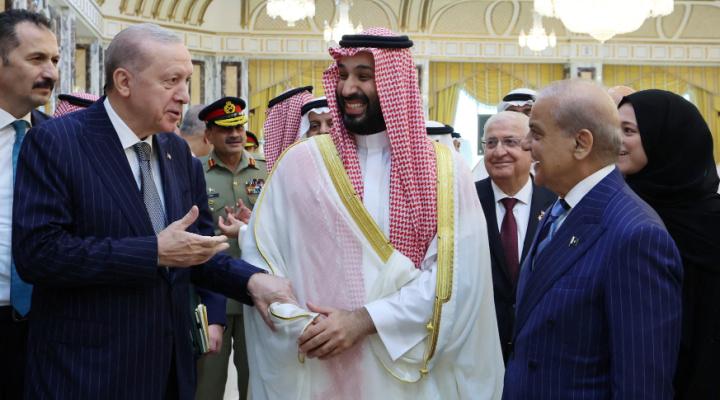
Turkish President Tayyip Erdogan, Saudi Crown Prince Mohammed bin Salman, and Pakistan’s Prime Minister Shehbaz Sharif chat after signing a joint defense agreement in Mecca, Saudi Arabia, Aug. 7, 2026. Photo: Murat Cetinmuhurdar/Turkish Presidential Press Office/Handout via REUTERS
Attacks claimed by the Houthis targeted King Khalid International Airport in Riyadh and Abha International Airport, killing three people and injuring 36, according to Saudi authorities. Meanwhile, near the Bab el-Mandeb Strait, fighting has intensified over strategically important territory along the waterway, increasing the risks facing commercial shipping corridors.
The significance of these attacks goes beyond the physical damage at individual airports. The Arabian Peninsula can no longer be treated as a geographically insulated theater of Middle Eastern conflict. It is becoming a battlefield in its own right.
For much of the past decade, the Gulf has increasingly been associated with economic transformation, mega-projects, and diplomatic normalization. Yet economic power and geographic distance have not insulated the Gulf from the region’s expanding missile, drone, and maritime threats.
In recent years, Israel often viewed the Gulf primarily through the lens of diplomatic and economic opportunity. The Abraham Accords reinforced that perception. But the current escalation exposes a more immediate reality: Israel’s interest in Saudi stability does not depend on whether Riyadh eventually signs an agreement with Jerusalem.
The crisis also exposes the limits of Riyadh’s strategy of economic transformation, diplomatic de-escalation, and strategic autonomy. Crown Prince Mohammed bin Salman has sought to reduce Saudi Arabia’s exposure to regional confrontation, including through the 2023 Beijing-brokered restoration of relations with Tehran.
But diplomatic reconciliation with Tehran has not removed the military networks operating around Saudi Arabia, nor has it eliminated the Houthis’ ability to threaten the kingdom.
Iran has repeatedly used regional partners and aligned armed groups to extend its strategic reach while complicating direct retaliation against Tehran. Iranian support has provided the Houthis with political backing and military capabilities including ballistic missiles, cruise missiles, and drones. These capabilities allow non-state actors to strike infrastructure deep inside foreign territory and threaten international maritime traffic around strategic choke points throughout the Red Sea corridor.
For Jerusalem, the implications are profound. To understand why events in Riyadh and the Red Sea affect Israeli security, strategists must grasp a fundamental reality: The geography has not changed, but the threat geometry has.
For Israel, the problem is not that Saudi Arabia has suddenly moved closer on the map. The physical geography remains identical. What has changed is the ability of missiles, drones, maritime attacks, and proxy forces to connect theaters that once appeared strategically separate.
When missiles and drones cross national borders, early warning and air defense become increasingly interconnected. Repeated attacks could force Riyadh to concentrate more of its defensive resources on protecting critical infrastructure, while reducing the capacity available for broader regional surveillance. For Israel, that matters because the Red Sea is not a sealed security zone. A deterioration in Saudi defenses could create additional opportunities for Iran-aligned actors to operate across the maritime and aerial space surrounding the peninsula.
Riyadh is already seeking additional defensive support as the attacks intensify. Turkey is providing defensive and technical assistance, while Saudi Arabia is also looking to Pakistan for support. But none of these arrangements answers the fundamental question Jerusalem must now confront: What happens when instability on the Arabian Peninsula begins altering Israel’s own strategic environment? External diplomatic arrangements and transactional backing cannot substitute for cohesive early warning and defense.
The logic for Israeli-Saudi security coordination therefore exists independently of normalization. Intelligence sharing, early warning, and maritime surveillance are not rewards for diplomatic recognition. They are practical tools for managing a common, evolving threat environment.
Much of the public discussion surrounding Israeli-Gulf security cooperation has been linked to future normalization, commercial partnerships, and formal diplomatic arrangements. In a theater increasingly defined by drones, missiles, and maritime disruption, operational coordination is a functional necessity, not a diplomatic luxury. It represents a baseline defense requirement.
Israel is already confronting threats across a connected arc extending from Lebanon and Syria through Iraq and Yemen toward the Arabian Sea. The danger is not that every front will merge into one single, unified war. It is that pressure on one theater can increasingly produce severe consequences in another. If Saudi infrastructure is repeatedly targeted, the consequences could extend beyond the kingdom’s borders. They could affect shipping, energy markets, regional military deployments, and the behavior of Iran and its partners across multiple arenas.
The answer is not an Israeli security guarantee for Saudi Arabia. Riyadh remains responsible for defending its territory, infrastructure, and airspace. Jerusalem’s responsibility is different: to understand how deterioration in Saudi security could alter the environment in which Israel itself operates. A sustained erosion of the kingdom’s defenses could give hostile non-state actors and their patrons greater room to operate across the region.
Addressing this reality requires a regional architecture capable of detecting threats earlier and making attacks harder to execute. That could include shared early warning, faster intelligence exchanges, and greater maritime awareness across the Red Sea basin. None of this requires a public alliance or formal treaty signed before international cameras.
The economic consequences are already visible. Brent crude climbed to about $104.75 a barrel on Oct. 8 as concerns over Middle Eastern supply disruptions and shipping attacks intensified. The point is not simply that oil becomes more expensive. Escalation around the Red Sea and Gulf can increase pressure on shipping, insurance, infrastructure, and investment across the region. For Israel, that means economic disruption and military insecurity are no longer separate problems. They increasingly reinforce each other in real time.
In earlier policy debates, discussions in Jerusalem centered on what Israel might gain from Saudi Arabia in a theoretical diplomatic bargain. That framing is becoming inadequate. The immediate question is no longer what Israel might receive from Saudi Arabia at a signing ceremony. It is whether instability inside the kingdom’s security environment can be contained before it reaches Israel’s own strategic perimeter.
Amine Ayoub, a fellow at the Middle East Forum, is a policy analyst and writer based in Morocco. Follow him on X: @amineayoubx.


