


‘Holding Liat’ Is a Gripping Oct. 7 Documentary That Is Different — and Worth Your Time
Error: Contact form not found.

 by Alan Zeitlin

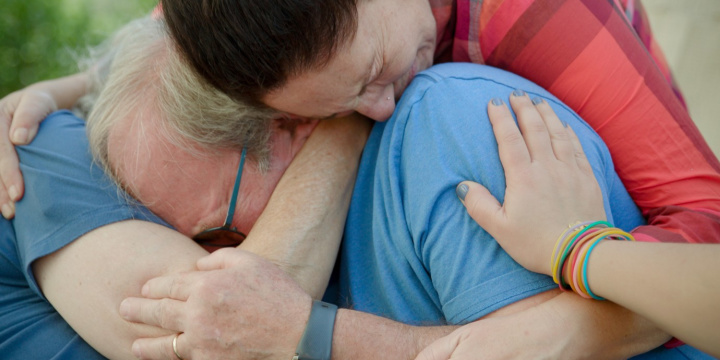
A still from “Holding Liat.” Photo: Provided.
We do not see or hear shooting or any shouts from Hamas in the award-winning documentary Holding Liat, in which the parents of teacher Liat Beinin Atzili are hit with the horrific reality that their daughter has been kidnapped by Hamas along with her husband, Aviv.
For those too squeamish to see harder hitting documentaries, this is one that focuses on the emotions of American parents who have moved to Israel and hope, by some miracle, their daughter is returned alive.
Liat’s parents have two different approaches. Yehuda is vocal, goes to meet American politicians, and will say whatever he feels like, including, at times, harsh words about Israeli Prime Minister Benjamin Netanyahu. Advisers tell him the best strategy is to focus on getting his daughter and son-in-law back.
Directed by Brandon Kramer and produced by famed director Darren Aronofsky, it is a gripping documentary worth seeing. Nobody can know the horror of a parent wondering what has happened to their child being held hostage by terrorists. We see a week-by-week progression of what is going on.
First, Liat is not on a list of hostages being returned. Then there is information that there is blood of Aviv, making them think the best-case scenario is he is wounded but alive.
A strength of the film is when we see Liat’s teenage son, Netta, who speaks forcefully and is up to the cause of fighting for the return of his parents, despite being the youngest of three and a teenager. The film would have been better served to give him more screen time, including his emotions about surviving the day.
The couple was taken from Kibbutz Nir Oz, and Liat’s parents were supposed to be there on that day, but plans changed.
Holding Liat has won several awards, and the film does well to pull at your heartstrings, especially when Liat is returned to her family.
But there are two adjustments that would have made it a stronger film. The first is we don’t know enough about either Liat or her husband, Aviv. And Liat doesn’t want to talk about Aviv, which is understandable in the heat of the moment, but it is a disservice to the viewers that we don’t get to see her reflections at a later date.
Also, Yehuda is presented in a bizarre way — when he hears chants of “Am Yisrael Chai” or “Love Live Israel,” he says it is propaganda. He should have been asked to explain what he meant by this. How is it propaganda? He is surely not sympathetic in that moment, though he is later, when he breaks down and cries.
And because we haven’t learned enough about Liat, her arrival is a bit anticlimactic — we know little about her other than she is a teacher and doesn’t want to be seen as merely a survivor.
The film is unique because it doesn’t look for the razzle-dazzle; it shows a slice of life of two American parents who made a life in Israel, never expecting that their daughter and son-in law would be taken hostage.
It was shortlisted for last year’s Oscars, but I would not expect any film that had anything to do with Oct. 7 to get a real shot at the Best Documentary Category.
Yehuda speaks in a way about solving the conflict with peace, which is a nice thought, but won’t likely happen any time soon — yet he should be allowed to express and think whatever he wants. After all, few would have thought Israel could win the wars it has won, and nobody thought something like Oct. 7 could ever happen in the first place. So, even as I write that something doesn’t appear realistic, I could be wrong, and I would certainly be happy to be wrong if meant seeing a true peace.
I did cry in the brief moment we see Aviv in the documentary. You can tell he had a kind soul. Why was he killed when others were not? Was it random? We have no way to know other than he bravely fought back on the morning of Oct. 7, likely having no idea that Hamas could have been capable of such an attack.
Holding Liat is an important film that humanizes people who didn’t ask to be in a documentary and found themselves in a nightmare that no parent should find themselves in. I have spoken to several parents, whose children did not come home, as they were murdered by Hamas, and all the conversations have been extremely difficult.
In a world where people are looking for psychological thrillers and “true crime,” Holding Liat is a psychological study of reacting to an awful terrorist crime and how some try to hide their emotions and deal with obstacles Olympians would not be asked to hurdle over.
The author is a writer based in New York.