

The New York Times’ Uncanny Knack for Finding the ‘Right’ Israelis
Error: Contact form not found.

 by Rachel O'Donoghue

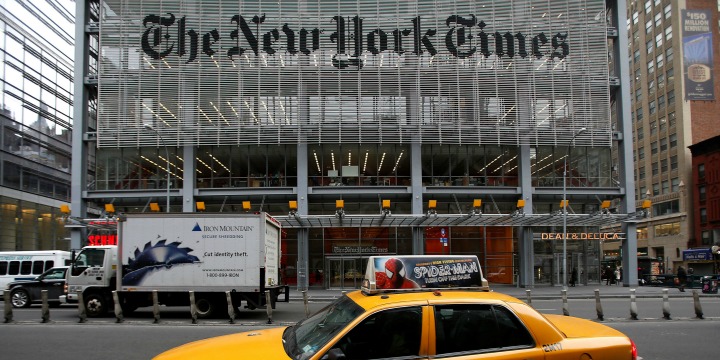
A taxi passes by in front of The New York Times head office, Feb. 7, 2013. Photo: Reuters / Carlo Allegri
You might call it good luck. Perhaps even an astonishing coincidence. Somehow, whenever The New York Times reports on Israel, or makes space in its opinion pages for an Israeli voice, it has an uncanny knack for finding precisely the Israelis who already agree with The New York Times.
We would suggest there is rather less chance involved, though. We might even propose that once the Times settles on its framing, it goes looking for the Israelis best placed to validate it.
The latest example arrived this week under the headline “Israel’s Elimination Project,” a guest essay by Yuli Novak, executive director of B’Tselem, an Israeli human rights organization beloved by the international media for its willingness to deploy all the right vocabulary: “apartheid,” “genocide,” “ethnic cleansing.”
In 2021, B’Tselem declared that the entire area under Israeli control, from the Jordan River to the Mediterranean Sea, constituted a single “apartheid” regime. In 2025, it reached the “unequivocal conclusion” that Israel was committing genocide in Gaza. Today, the West Bank becomes an Israeli project of “elimination.” One suspects the Times opinion desk was not kept in unbearable suspense over where Novak might be going with this piece.
Novak’s own résumé provides few plot twists. From 2012 to 2017, she ran Breaking the Silence, an organization of former Israeli soldiers whose anonymous testimonies have generated years of controversy over accuracy and verification, if rather less hesitation among the international media outlets eager to quote them.
Now, as head of B’Tselem, she is making headlines with the latest accusation: “elimination.” Novak explains that this particular process does not actually require Palestinians to be eliminated. Instead, it describes a “logic” that makes Palestinian collective life increasingly impossible. How conveniently elastic.
If “elimination” meant what most readers might reasonably assume it means — removal or destruction — she might have to contend with the awkward matter of a Palestinian population in the West Bank that continues to grow. The Palestinian Central Bureau of Statistics itself put that population at 3.43 million at the end of 2025.
So why Novak? Why does the Times hand its opinion page to the head of an organization that had already accused Israel of apartheid, genocide, and ethnic cleansing? And why does the whole exercise feel so familiar?
In June, the Times commissioned Israeli analyst Yonatan Touval to explain that American support is “Israel’s true weakness.”
In July, came Israeli-American historian Omer Bartov, warning readers in a guest essay that we are entering a “terrifying new era of genocide.” Then, in August, came “These Generals Fought for Israel. Now They See ‘Jewish Terrorism’ as the Threat,” in which the Times assembled an impressive collection of former Israeli security figures whose condemnations were presented as a striking awakening — provided, of course, one stopped reading at the military résumés. Look a little further and the impression of hardened security hawks undergoing some sudden revelation became rather harder to sustain.
There is a reason for this. The New York Times has a view of Israel, but that view acquires rather more authority when an Israeli can be found to express it. An American accusing Israel of apartheid, genocide, ethnic cleansing or “elimination” is just another critic. Put the same accusation in the mouth of an Israeli and suddenly it comes with a useful little rhetorical flourish: Look, even the Israelis say it.
And therein lies the trick. Israel has millions of citizens with wildly different political views, including generals, academics, activists, and former officials. Yet whenever the Times needs an Israeli voice to validate its bleakest conclusions about the Jewish state, it demonstrates an uncanny ability to find exactly the right one.
The author is a contributor to HonestReporting, a Jerusalem-based media watchdog with a focus on antisemitism and anti-Israel bias — where a version of this article first appeared.