






Israel-Lebanon Deal Under Strain as Hezbollah Disarmament Falls Short
Error: Contact form not found.

 by Ailin Vilches Arguello

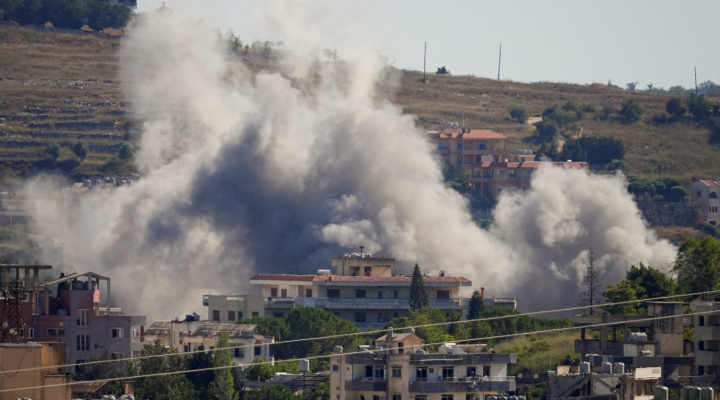
Smoke billows from southern Lebanon following an Israeli strike, as seen from Nabatieh, southern Lebanon, June 19, 2026. Photo: REUTERS/Stringer
Two months after Israel and Lebanon signed a US-brokered memorandum of understanding, frustration is mounting in Jerusalem as the Lebanese army falls short of its pledge to dismantle Hezbollah’s military infrastructure in the country’s south — threatening to stall the fragile agreement before the two sides can move to the next stage of negotiations.
The Meir Amit Intelligence and Terrorism Information Center (ITIC), an Israel-based research institute, released a new report on Friday warning that the pilot program in southern Lebanon has failed to deliver on the security commitments outlined in the MoU between Beirut and Jerusalem, as the Lebanese army has yet to demonstrate that it can disarm the Iran-backed terrorist group and establish a state monopoly over weapons in the country.
ITIC’s data shows that Hezbollah is not only refusing to give up its weapons but also remains firmly entrenched in the country’s south, with affiliated and allied organizations maintaining a strong presence on the ground, providing a civilian front for the Islamist group’s military-terrorist activities and helping it preserve its foothold in the area.
Under a US-brokered framework, Israel and Lebanon signed a MoU in June outlining the Israeli military’s withdrawal from the country’s south and the transfer of security responsibility to Lebanese authorities.
Although the agreement did not set fixed deadlines, it established pilot zones to test the parties’ compliance and assess whether the Lebanese army could dismantle Hezbollah’s infrastructure and prevent the terrorist group from reestablishing its presence in the area.
According to the ITIC’s assessment, the Lebanese army is both failing to uphold the agreement’s terms and effectively allowing conditions that violate them, as Hezbollah-linked organizations continue operating openly in the pilot zones and the government struggles to confront the group’s extensive civilian infrastructure.
The army’s efforts are further complicated by legal restrictions that limit its ability to search private properties, which are widely known to be used by the terrorist group as civilian cover for its military-terrorist infrastructure.
Among the two most prominent organizations operating in the area are the Islamic Health Organization, which falls under Hezbollah’s Executive Council, and the Wa Ta’awanu Association, which runs aid programs and supports the reconstruction of civilian infrastructure.
Established in 1984, the Islamic Health Organization provides medical services to Shi’ite communities as well as Hezbollah’s operatives, through a vast network of hospitals, medical centers, and clinics across Lebanon, particularly in the south. ITIC points to its extensive presence as a key part of the civilian infrastructure that supports and shields Hezbollah’s terrorist activities.
For its part, the Wa Ta’awanu Association provides food and housing assistance to local residents but has long been suspected of also serving as civilian cover for Hezbollah’s activities in the area.
According to a report by the Israeli news outlet Walla, Israel has warned the United States that the pilot program in southern Lebanon has failed, sharply criticizing the Lebanese army’s efforts and accusing it of failing to effectively dismantle Hezbollah’s infrastructure in the country’s south.
Israeli officials have reportedly accused Lebanese Army Chief of Staff Rudolf Heichal of continuing to cooperate with Hezbollah, avoiding confrontation with the terrorist group’s commanders and failing to carry out effective operations to locate the group’s infrastructure and weapons.
Hostilities between Hezbollah and Israel reignited on March 2, when the terrorist group opened fire in support of Iran two days after the start of the joint US-Israeli military campaign against the Iranian regime.
Since then, Israeli forces have established a “buffer zone” extending into southern Lebanese territory, which officials say is meant to shield northern residents from Hezbollah attacks amid thousands of rockets and drones fired throughout the war.
Even though a US-backed ceasefire has sharply reduced violence, negotiations and prospects for lasting peace remain fragile, with Israeli forces still launching strikes while positioned in southern Lebanon to maintain its buffer zone and dismantle Hezbollah military infrastructure.


