


The New York Times Refuses to Acknowledge the Harm and Demonization Its Reporting Has Caused
Error: Contact form not found.

 by Jennifer Kouzi

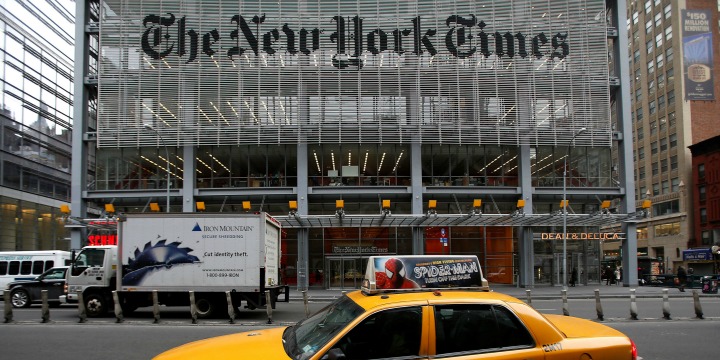
A taxi passes by in front of The New York Times head office, Feb. 7, 2013. Photo: Reuters / Carlo Allegri
In the hit TV series “The Office,” Michael Scott frequently berates Dwight for lacking self-awareness, completely blind to the fact that the rest of the office views Michael the exact same way.
In “How a False Nuclear Claim About Iran Ricocheted from India to Washington,” (Aug. 16, 2026), The New York Times thoroughly scrutinized how a single unverified claim traveled from an anonymous social media post to hyper-partisan influencers, to earning mainstream news coverage and more. The article chronicled how the claim appeared on Israeli accounts, then on an Israeli television station, then into Israeli Prime Minister Benjamin Netanyahu’s own remarks, and how it was repeated in the US by Ambassador Mike Waltz, Senator Rick Scott, and reported by Fox News.
For those who have been critical of The New York Times and its coverage of Israel, some of the language in the article was jaw-droppingly accurate about the paper itself:
- “The claim’s spread showed how easily viral disinformation can twist the public debate over matters as serious as war and peace.”
- A disinformation and propaganda tracker “described the spread of the claim as a textbook case of narrative laundering, a tactic that propagandists use to seed and then shuffle falsehoods through enough sources to make them seem authentic.”
- The co-founder of an Israeli fact-checking organization explained the nuclear claim quote “gained credibility every time an outlet or a politician repeated it.”
In other words, The Times is Michael Scott.
In the article, the authors clearly identified how narrative confirmation was prioritized over verification, how the claim was institutionally laundered, and the effect of the radical asymmetry in how little of the original audience sees the correction.
But The Times has done this very thing. Multiple times. In fact, on Thursday The Times was just ordered to pay one of its victims $9.25 million after relying on a single anonymous source to falsely accuse him of being at the scene of a murder.
How can The Times not see the same fault in itself?
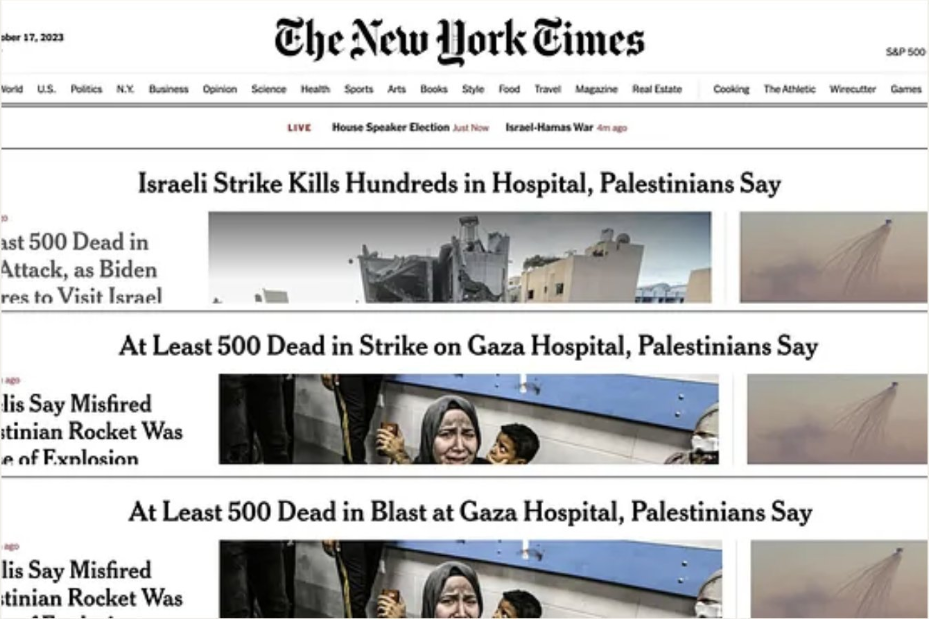
When it prematurely accused Israel of striking the Al-Ahli Hospital on Oct. 17, 2023, (in fact it was an errant Palestinian Islamic Jihad rocket) the international public believed it because it was published in the “paper of record.” When it splashed on its front cover a photo of a skeletal Gazan child, alleging Gazans were dying of starvation while not telling its readers the truth about the preexisting health condition of the child, the world believed it.
With The Times’ readership – over 12 million subscribers and nearly 54 million followers on the X social media platform – the paper has been a preeminent source of viral disinformation. Its belated corrections for the hospital and unhealthy child stories ensured only a miniscule fraction of those who saw the initial story and photo learned the truth. But the damage had already been done.
Between The Times’ initial report on the hospital strike and when it published the Editor’s Note nearly a week later, the US’s Anti-Defamation League and Germany’s RIAS recorded some of the highest, single-week spikes in antisemitic incidents in modern history. The Central Council of Jews in Germany said Hamas’ blame of Israel for the Al Ahli event [which The Times parroted] “might have played a role in fomenting hate.” To name just a few examples of what transpired during that six-day period: a Tunisian synagogue was burned to the ground (Oct. 17 – 18), a Berlin synagogue was firebombed (Oct. 18), and there were multiple attempts to storm the Israeli embassy in Jordan (Oct. 18).
The Times has also repeatedly participated in the institutional laundering of unverified claims, where each step in the chain treats the previous party’s repetition as evidence of credibility. For example, a claim originates from the Hamas-run Gaza Health Ministry, is picked up and published by UN agencies (such as OCHA), may or may not be used in a “study,” and is then cited by The Times while being labeled as a “UN figure” or “UN assessment,” giving a terrorist organization’s unverified claim prestige and authority.
On Feb. 29, 2024, The Times published “Gaza Death Toll Surpasses 30,000 Health Ministry Says;” even its subheading said “experts” believed this number to be an undercount. The authors cited to several sources: a social media post by the director-general of the World Health Organization who [falsely] claimed most of those killed in Gaza were women and children; unnamed “international observers” who thought the death toll was reliable; and a Lancet article published in November 2023 that “suggested reasonable data quality” and “likely to be largely civilian.”
The Lancet piece was authored by Hamas-adjacent Zeina Jamaluddine and co-author Francesco Checcki who later made the stunning and baseless claim in April 2024 that he had never seen such rates of starvation as in Gaza after studying humanitarian crises for 20 years, including the Somali famine. (On June 4, 2024, an Integrated Food Security Phase Classification assessment by the UN’s own Famine Review Committee said it could not endorse prior analysis that famine was actively occurring in April when Checkki made the statement.)
A mere two months later, the UN lowered its count of women and children killed in Gaza, something The Times reported. But this has not stopped the paper of record from continuing to publish statistics based on sources that had already had to backtrack.
The Times did readers a service when it applied a critical framework and correctly diagnosed how modern misinformation spreads. But it also demonstrated its own stunning inability to look inward and recognize how it has caused incalculable damage by doing the same exact thing in the past. Whether an unverified claim originates from an anonymous X account in India or a press briefing in Gaza, the breakdown in journalistic standards is the same.
The author writes for the Committee for Accuracy in Middle East Reporting and Analysis (CAMERA), where a version of this article first appeared.


