


How Subtle Language Delegitimizes the Jewish Connection to Israel
Error: Contact form not found.

 by Sharon Levy

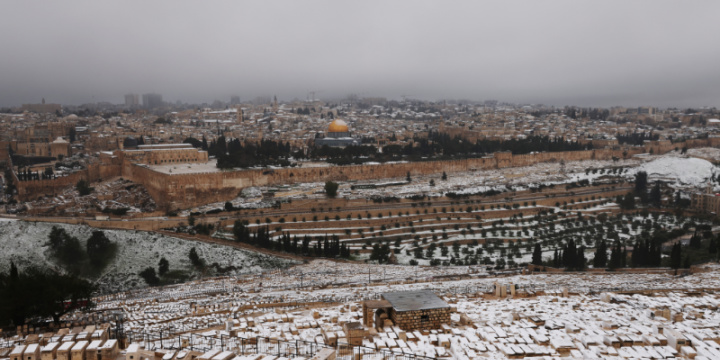
Snow is seen over Jerusalem and on the Dome of the Rock, located on the compound known to Muslims as Noble Sanctuary and to Jews as Temple Mount, in Jerusalem’s Old City, Feb. 18, 2021. Photo: REUTERS/ Ronen Zvulun
The Jewish people have a long and undeniable connection to the Land of Israel, as evidenced by centuries of archaeological evidence, Biblical history, and a continuous Jewish presence. Yet this connection has increasingly been filtered through a different lens in media coverage by top outlets worldwide. It is a lens that portrays Jewish history as a political claim, Jewish terminology as partisan, and Jewish presence in Israel as inherently controversial.
This isn’t merely theoretical. HonestReporting.ai Labs analyzed articles from major outlets including The New York Times, The Times, The Guardian, and CNN from June 1, 2025, through August 5, 2026. Rather than outright denying Jewish history, outlets often rely on a subtler form of delegitimization. By deploying language that appears neutral on its face, the media can diminish Jewish connection to the land by framing Jewish presence as the issue.
Loaded Terminology Describes Jewish Historical Sites
The Temple Mount is revered by the Jewish people as their holiest site, having been the location of both the First and Second Temples. As it is still under administration by the Jordanian Waqf, Jewish access to the Temple Mount is restricted to certain times and public prayer remains prohibited. Still, the holiness of the location draws many Jewish people to visit the grounds, where they are monitored under police supervision, ensuring that no conflict breaks out.
Yet from reading the news, the opposite impression is conveyed. Of the 410 articles examined by HonestReporting.ai Labs, 126 contained at least one keyword associated with loaded descriptions of Jewish visits to the site. A review of all 126 articles found that 63, or 15.4%, were verified as using loaded terminology to refer to Jewish visits with words including “storm,” “raid,” “incursion,” “desecration,” “defile,” “extremists,” or a “provocative visit.” Some articles used more than one loaded term, resulting in a total of 198 per-term counts.

This is language that was once limited to pro-Palestinian or Islamic media outlets. The usage of these loaded terms in mainstream reporting on the Temple Mount thus marks a significant shift. When the vocabulary used to describe a site is no longer neutral, neither is the rest of the report built around it.
The problem extends beyond the terms used to describe Jewish visitors, but to the holy site itself. In the same set of articles analyzed, 49 name the location as the third-holiest site for Muslims, while omitting that it is the holiest site for the Jewish people, subtly influencing the narrative of why the site is so important to begin with and leaving readers with an incomplete understanding of why the site carries such extraordinary weight to different peoples.
This terminology is not limited to the Temple Mount. While less common, it can and has spread to other holy sites, such as the Cave of the Patriarchs in Hebron, known to Muslims as the Ibrahimi Mosque. When the Jewish connection is delegitimized, it again signals that Jews are foreign to the land that they originate from – even when the very site in question is proof of the Jewish connection.
The pattern of loaded terminology extends beyond specific sites to the very names used to describe the land itself. In Hebrew, the common terminology used to refer to the West Bank is Judea and Samaria – the biblical names of the land. It is not an identifier of specific policies, beliefs, or religiosity, but simply reflects the ancient connection the Jewish people have with the land.
In 456 articles from top outlets that used the term Judea and Samaria, 206 articles attributed the name to a specific actor. Of these articles, 136 correctly note that these names are biblical terms.

But around one-third of the 206 articles attribute the name Judea and Samaria not to its historical standing, but to a political actor. Twenty-nine articles write “Israel” or “Israelis,” suggesting that it is a modern Israeli invention, and 14 articles specifically refer to the Israeli government. Additionally, eight articles attribute the language to the Israeli right or religious Zionists, and another five of the articles attribute the language directly to settlers, implying that this language is exclusive to one political group or ideology.
Another 11 articles use phrasing such as “now universally described” that implies only recently has the term Judea and Samaria become normalized language in Israeli society, rather than an ancient name used continuously amongst the Jewish people.
The subtle delegitimization of the Hebrew name Judea and Samaria further enables the media to level accusations against Israel that serve to deny the Jewish people’s indigenous identity and their historic connection to the land. A recent BBC article, for instance, accused Israel of “weaponizing archaeology,” while omitting that the very archaeology it described was in the ancient capital of the Kingdom of Israel and later a major city in the Kingdom of Judea. Jewish historical presence is thus presented as false evidence of modern political manipulation.
Jewish presence, terminology, and archaeology are turned into a modern Israeli political agenda rather than being exemplary of the historical connection the Jewish people have to the land.
The issue is not simply which names or descriptions the media uses, but what those choices teach readers about Jewish history. When loaded terminology is attached to Jewish historical sites or Jewish names, a carefully crafted narrative works to cast modern Jewish presence as political and foreign, overlooking the deep-rooted Jewish connection to the land. By stripping the Jewish people of that very connection, evidence of their longstanding presence is reframed as an argument against their right to be there.


