



The New York Times’ Anti-Israel Bias Is on Full Display
Error: Contact form not found.

 by Jennifer Kouzi


The New York Times building in New York City. Photo: Wikimedia Commons
A recent New York Times article endeavors to show readers present-day Gaza with a series of photos by a Pulitzer prize-winning Gazan Times photojournalist. There is no acknowledgment by The Times, however, that this same photojournalist was responsible for a grotesque blood libel during the two-year Israel-Hamas war – one that The Times put on its front page and has yet to apologize for.
About a year ago, Saher Alghorra photographed an emaciated young boy, Mohammed Zakaria al-Mutawaq, cradled by his mother. The photo was placed on the front page of The New York Times on Friday, July 25, 2025, and online the day prior, in a story called “Gazans Are Dying of Starvation.” The caption falsely claimed that Mohammed had been born healthy before suffering from malnutrition during the war. It took several days, after The Times had been accused of advancing a blood libel, for the paper to revise the story to include that the child had underlying medical conditions that affected his muscle development.
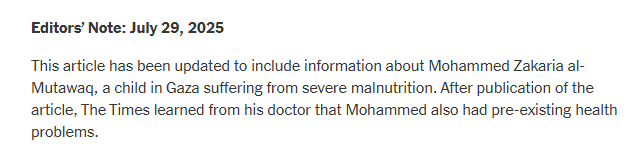
The Times notably posted its Editors’ Note on the @NYTimesPR social media account on X, which has approximately 96,000 followers, instead of the general @nytimes social media account on X, which has 53.7 million followers.
Apart from the fact that Alghorra and The Times perpetrated a big lie about famine in Gaza, one which most Americans believed, there is something else notable about his work: namely, what is missing from it – Hamas.
Katrin Bennhold introduces “Still Waiting for Peace in Gaza,” (Aug. 9) by explaining that since the October 2025 cease-fire, Gaza has continued to see IDF strikes and deaths. She further explains that both the war and the ceasefire “ha[ve] been hard to cover because Israel has barred foreign journalists from entering the territory.” This, Bennhold tells her audience, is why she wants to introduce readers to Gazan photographer Saher Alghorra, who, she says, “has been documenting the war for The New York Times and this year received a Pulitzer Prize for his work.” The Times also linked to the piece which included the photos for which he was awarded the prize.
But in the last nearly three years, in addition to his blood-libel-by-photo, Alghorra has engaged in what some critics have termed “late photography,” the phenomenon that takes the active combat out of the photography. While the argument could be made that Alghorra also did not photograph the Israeli military, who many blame solely for Gaza’s destruction (except for one photo of a strike on a mosque), the omission of Hamas from his photojournalism, given not only how the terror group started the war, but how it devastated Gaza by virtue of its vast tunnel network and embedding in civilian infrastructure, is nothing short of stunning – and completely rewrites the narrative.
Ignoring the major scandal of last year’s photograph, Bennhold holds Alghorra up as one who shines a light on the sea of Gaza’s darkness. The photos included in his piece feature children, adults embracing, mass prayer and eating outside next to destroyed buildings, smoke and flames from Israeli airstrikes, mass funerals, and a sea of men watching the Argentina-Egypt World Cup match.
While it is easy to see Alghorra’s photos that The Times chose to publish, one question readers should ask is: What, from this war, has not been presented?
How did Alghorra photograph a years-long war with no photos of any military activity on the Gaza side? Not one militant is photographed. Not one tunnel entrance. Not one green (Hamas) bandana. No rocket launchers, no horrifying hostage release ceremonies, no riding around on pick-up trucks with guns shooting into the air. Not even, as political theorist and essayist Shany Mor noted, a uniformed Gazan taking a smoke break.
Alghorra showed the world nary a single photograph demonstrating this was a two-way fight.
In addition to pointing out this noticeable omission, Mor noted that at the outset of the Israel-Hamas war, the terror group’s ground forces numbered approximately 40,000 – larger than the armies of most NATO countries.
How hard did Alghorra have to work to avoid photographing a single combatant in Gaza? Or was his work subject to Hamas censorship?
The Times’ publication of Alghorra’s carefully curated photo subjects is also interesting in light of a contemporaneous article it published the following day, entitled “Netanyahu Walks ‘Political Tightrope’ on Trump’s Gaza Disarmament Deal” (Aug. 10), by Adam Rasgon and Aaron Boxerman. In it, the authors briefly mentioned Hamas’ Oct. 7, 2023, invasion and attack on Israel, which killed approximately 1,200 and saw 251 kidnapped as the catalyst for the Israel-Hamas war.
The article featured three photos: one, by Alghorra, of several Palestinians near a pile of rubble “inspecting a house after it was hit by an Israeli strike late last month” and a second by another Times photographer, of an Israeli soldier inside a Gaza tunnel.
Just as Alghorra’s work never showed Hamas, neither did the third photograph in Rasgon and Boxerman’s piece. Captioned to portray the aftermath of Hamas’ Oct. 7, 2023, Nova Music Festival massacre, the photo depicted little more than a few tents and abandoned trash. Absent were any indicators of the rocket fire, raping, shooting, killing or kidnapping that took place on that day. Rather than convey the reality of the massacre, the image presented a sanitized scene that offered readers no context or explanation whatsoever.
The same way the photos Alghorra took omitted Hamas from the story and spread a famine libel like wildfire, the paper’s poor photo choice intentionally obfuscated what went on at the Nova Music Festival and elsewhere in southern Israel on Oct. 7, 2023.
The New York Times’ audience deserves candor, not curation.
The author writes for the Committee for Accuracy in Middle East Reporting and Analysis (CAMERA), where a version of this article first appeared.