





Mounting Antisemitic Attacks, Institutional Failures Leave Canadian Jews Asking: Stay or Go?
Error: Contact form not found.

 by Atara Beck

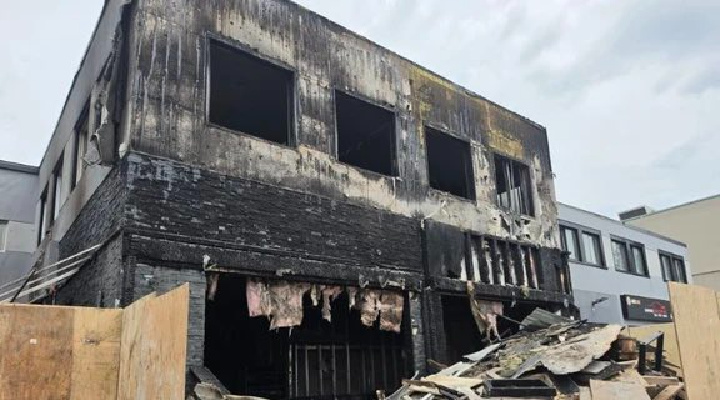
The remains of a kosher restaurant in Montreal’s Côte-des-Neiges neighborhood are seen after a weekend fire caused extensive damage in an incident police are investigating as possible arson amid a wave of antisemitic attacks targeting the city’s Jewish community. Photo: Screenshot
Rabbi Daniel Korobkin, spiritual leader of Beth Avraham Yoseph of Toronto Congregation, Canada’s largest Orthodox synagogue, moved from Los Angeles to the Greater Toronto Area in 2011.
Comparing Canada then and now, “I think it’s two completely different countries,” he told The Algemeiner. “This isn’t just my opinion. I speak to Canadians who have lived here their entire lives.”
Korobkin and his wife moved from the United States to Canada “because we saw it as a goldene medina, just like the United States,” he explained.
However, after then-Prime Minister Stephen Harper was unseated by Justin Trudeau in 2015, the prominent rabbi described a slow decline in the Canadian economy, followed by infringements on individual freedom during the COVID pandemic. But that “does not necessarily spell disaster for the Jewish community because the Jewish community had not been singled out,” he noted — until everything changed.
“Then we got to Oct. 7, 2023,” Korobkin said, referring to the Palestinian terrorist group Hamas’s invasion of and massacre across southern Israel.
Korobkin’s story is one of several relayed by Jewish leaders, activists, and experts who spoke to The Algemeiner about what has become an alarmingly hostile environment for Canadian Jews, many of whom are now actively discussing whether to emigrate from a country they once considered a haven.
Just last month, the national statistical office of Canada revealed that Canadian Jews were the targets of more than 70 percent of religion-motivated hate crimes and 16.7 percent of all hate crimes, regardless of category, reported to police in 2025, despite making up less than 1 percent of the country’s population.
According to observers on the ground, one source of this surging antisemitism is a growing Muslim population comprised largely of immigrants from regions where animus toward Israel is rampant.
“There are at least five or six times as many Muslims as Jews in Canada today, and the Muslims have organized themselves,” Korobkin said. “They have really got their act together … and part of the Islamist philosophy or creed is to bring sharia law to wherever they live.”
Korobkin stressed that this is “not representative of the entire Muslim community.” However, he noted, “in many of the radicalized Muslim voices that we see today, just like we see it in the UK and France and Australia, the creed is to dominate and silence all dissenting voices.”
According to Korobkin, the Jewish establishment in Canada is not handling the problem the way it needs to.
“I think there’s a certain amount of kowtowing to Canadian political leaders. It’s a strategy that I don’t think will work,” he lamented. “When the UJA [United Jewish Appeal] tells you that they scored a great victory in getting more security funding, all that means is that they managed to convince the government to give us more money to build higher walls and barbed-wire fences around our institutions. That’s not a good way to fight antisemitism, but that’s all they’ve got right now.”
In contrast, the grassroots movements are “pushing back hard,” Korobkin explained. “They’re saying, ‘We’re going to be in your face. We’re not going to take this lying down. We’re not going to retreat into our ghettos and our higher-walled fences.’ And that, I think, is the difference between the CIJAs [Center for Israel and Jewish Affairs] and UJAs on the one side and the grassroots groups like Tafsik and Unapologetically Jewish and even B’nai Brith.”
Korobkin argued that some Canadian politicians are more concerned with electoral considerations than confronting extremism. “And that, I fear, is a recipe for a very dark future for the Jewish community in Canada.”
“That doesn’t mean that all is lost and there’s no possibility for course correction,” Korobkin added. “But I will say this: There has never been a worse time to be Jewish in Canada than today, perhaps with the exception of during World War II.”
The prime minister’s response to antisemitism
Prof. Irwin Cotler, international chair of the Raoul Wallenberg Center for Human Rights and a former justice minister, served as Canada’s first special envoy on preserving Holocaust remembrance and combatting antisemitism from November 2020 to October 2023.
Cotler said antisemitism had historically been viewed through a “triangular paradigm” of threats from the far right, far left, and radical Islam.
“However, my principal finding at the conclusion of my first year as special envoy in 2021 was that while this conventional paradigm remained, what we were now witnessing was the mainstreaming, normalization, and legitimation of antisemitism in the political culture, the popular culture, the entertainment culture, the sports culture, and, in particular, the campus culture, the whole amidst indifference and inaction, let alone the absence of outrage,” he explained.
In February, Prime Minister Mark Carney eliminated both the office of the Special Envoy on Preserving Holocaust Remembrance and Combatting Antisemitism and the office of the Special Representative on Combatting Islamophobia, replacing them with a broader Advisory Council on Rights, Equality, and Inclusion.
On June 1, in an address to the Jewish community at Holy Blossom Temple in Toronto, Canada’s largest synagogue, Carney acknowledged the rise in antisemitism and announced the official launch of the Advisory Council, chaired by Minister of Canadian Identity and Culture Marc Miller, saying its first priority would be tackling the antisemitism crisis.
The Advisory Council includes lawyer Avnish Nanda and former Transport Minister Omar Alghabra.
Nanda has represented anti-Israel students who were evicted from an encampment at the University of Alberta.
Alghabra is the former president of the Canadian Arab Federation, which, after his tenure, lost federal funding over its support of Hamas and Hezbollah. In 2022, he defended his attendance at a Canada-Palestine Parliamentary Friendship Group reception hosted by Nazih Khatatba, editor of an Arabic-language newspaper accused of spreading antisemitism. In 2005, Alghabra criticized then-Toronto police Chief Bill Blair for participating in a Walk with Israel event and traveling to Israel.
Carney’s speech “acknowledged the scourge of antisemitism and that the covenant with the Jewish community had been breached, but there was no reference to Israel, no reference to anti-Zionism as a cover for antisemitism, and there was no mention of the ongoing delegitimization, dehumanization, and demonization of Israel, which is what has, in effect, put a target on the back of every Canadian Jew,” Cotler said.
“Regarding the Advisory Council, as I said when it was announced, such a council, while necessary to combat all forms of hate, tends to marginalize or erase the singularity of anti-Jewish hatred, its globality, and its descent into standing threats of intimidation, harassment, violence and even terrorism.”
However, Cotler added, “the inclusion of Omar Alghabra and Avnish Nanda on the committee is not the problem — it is the establishment of yet another advisory council, with a broad-based agenda and without the requisite expertise to understand and combat antisemitism, when what is needed is moral, political, and juridical leadership at the highest levels, as an expression of what Prime Minister Carney has himself called a ‘whole of government’ policy.”

Canada’s Prime Minister Mark Carney speaks at a Hanukkah menorah lighting in Ottawa, Ontario, Canada, Dec. 14, 2025. Photo: REUTERS/Patrick Doyle
‘The golden age has ended’
For some community leaders, the post-Oct. 7 surge in antisemitism reveals not just a troubling level of hostility toward Canadian Jews but also the end of a “golden” era of acceptance and flourishing for them.
“I think the golden age of Canadian Jewry effectively ended Sept. 21, 2025. That was the date that Carney recognized the sovereign state of Palestine. That was the message to the Jews that you’re no longer welcome in this country,” Frank Dimant, former executive vice president of B’nai Brith Canada, told The Algemeiner.
As for the Advisory Council, “it’s ridiculous,” he said. “The time for studying antisemitism is long past. We know what antisemitism is. We know who’s behind it. We know the demographics in this country that are driving some of the antisemitism. We understand that.”
Dimant called out the council’s membership for including individuals who do more to foster than combat animus toward Jews.
“To add insult to injury, appointing a man who thought Hamas should be legitimized in this country, a man who supported the actions against Israel, a man who is no friend of our community should sit on an advisory committee on how to deal with antisemitism. That is literally spitting in the face of the Jewish community,” he decried.
“I would have expected a major outcry from the Jewish liberals,” Dimant continued. “I thought that this would be a moral test for them — a moment of truth, because the hypocrisy is so great and so evident. There was a whimper. Quite frankly, I would have expected Marc Gold to resign.”
The Algemeiner contacted Gold, a former law professor and senator who is the lone Jew on the council, but he was reluctant to grant media interviews before knowing “more about how the council will operate, what its work plan will be, and so on.”
The council met on June 29 to get to know one another, Gold said. “However, the draft workplan has not yet been circulated for our comments and input, so it is still premature for me to comment.”
As of this writing, he said, “there is no update.”
Miller told The Algemeiner that the council “met for the first time on June 29 to begin its work to advise on key actions to tackle antisemitism, strengthen social cohesion, rally Canadians around our shared identity, and combat all forms of racism and hate.”
“In the meantime, Canada is taking significant action to combat antisemitism and hate through a coordinated, whole-of-government approach,” he said.
“In 2024, the government launched Canada’s Action Plan on Combatting Hate. Since then, Canadian Heritage has provided approximately $18 million in funding to over 115 anti-hate projects across the country.”
‘Caught totally off guard’
Some in the Jewish community knew there would be “an outburst of antisemitism, but we didn’t know when it would come,” Dimant said.
“But we saw it developing in academia. We saw it being transmitted to students, the future leaders. Very often, I would speak on the dangers of the next generation that has been inculcated with so much hate against us and against Israel.”
Dimant recalled “the fight that B’nai Brith led against having Israel Apartheid Week at University of Toronto,” where it was launched in 2005.
“It was the trial balloon for having it throughout the world,” he said. “I remember our delegation met with the senior leadership of U of T, and we warned them that they’re opening a Pandora’s box that no one will be able to close.”
“Sadly, at that time, we were undermined by someone from the Jewish establishment who said it was a matter of academic freedom,” he said, declining to name the individual. “And the rest is history.”
The Jewish community was “caught totally off guard” in the aftermath of Oct. 7, Dimant continued, but the anti-Israel side was not.
“The fact that you had demonstrations the day after Oct. 7 throughout the world with the same kinds of slogans and the same kinds of placards shows they were prepared.”
While Dimant maintains that the Jewish establishment did not take the looming threat seriously enough, he praised the grassroots groups that emerged after the Hamas attack.
‘An unapologetic voice’
Matthew Taub had never been a community activist, but when his neighborhood became a battleground, he rose to the challenge.
His grassroots organization, Unapologetically Jewish, has 70,000 followers and a team of volunteers. It does not fundraise.
On International Holocaust Remembrance Day in January, there was “a beautiful ceremony in Ottawa attended by a couple of Jewish locals, a couple of rabbis, and organization representatives,” Taub said.
A week later, on the National Day of Remembrance of the Quebec City Mosque Attack and Action against Islamophobia, “the Muslims brought 200 youth to Parliament to meet with MPs and show them their culture,” he said. “And what do Jews do? They stand outside with their CEOs and make statements.”
“I want to bring a proud Jewish voice back to Parliament,” he said. “An unapologetic voice, because growing up, we were taught to be quiet.”
Taub has focused on direct activism, speaking with lawmakers, meeting with police, and helping bring cases to authorities that resulted in arrests.
“We’re in the middle of a forest fire. Everywhere we turn, there’s another tree on fire — antisemitic rallies, school boards. So much to deal with.”
“I believe there’s a future for Jews in Canada, but we have to fight for it. The pendulum is swinging one way. It has to swing back, but it’s only going to happen if everybody does something about it.”

People attend Canada’s Rally for the Jewish People at Parliament Hill in Ottawa, Ontario, in December 2023. Photo: Shawn Goldberg via Reuters Connect
Encouraging fellow Jews
“Like any other Jewish person feeling any connection to their people and to Israel, I was deeply traumatized by the events of Oct. 7,” said immigration lawyer Guidy Mamann, president of the Toronto Zionist Council.
Hamas leader Khaled Mashal called for a “Global Day of Jihad” on Friday, Oct. 13, 2023, Mamann recalled.
“Mainstream Jewish organizations advised parents to keep their kids home from school, not to wear kippot or Jewish symbols, and so on,” he said. “I didn’t agree with that.”
That Friday, Mamann and a couple of friends went to the corner of Sheppard Avenue and Bathurst Street, in the heart of the Jewish community, and stood waving Canadian and Israeli flags.
Many drivers stopped to thank them, some in tears, Mamann said. It became clear how deeply the situation had affected people, so they began gathering weekly. The crowd eventually grew to dozens.
“I vowed to go until every hostage in Gaza is returned,” Mamann said. “We went for 107 weeks straight — we didn’t miss a week, not even on Yom Tov — until every hostage was back home, dead or alive.”
School-sanctioned antisemitism in kindergarten
In May 2024, retired attorney Mark Sandler founded the Alliance of Canadians Combatting Antisemitism, or ALCCA, a coalition of organizations and individuals dedicated to combating rising antisemitism.
“What we’re finding in Canada is that there are so many instances of antisemitism that it’s an all-consuming exercise,” Sandler said. “And so, I deal with antisemites in the morning, in the afternoon, and in the evening.”
“I was the national chair of B’nai Brith Canada’s League for Human Rights in the ’80s,” he explained. “I was dealing with campus activity at Concordia and at McGill and York University and so on. But it wasn’t mainstream antisemitism at that point in time, and we were far more focused on neo-Nazi extremism and white supremacists at the time. The so-called progressive left was not the focus like it is now. And I think the Jewish community became complacent about its role in Canadian society.”
“We thought we had won the battle on antisemitism and that the people who were engaging in it were outliers,” he said.
“And I think a bunch of things contributed to that complacency,” he continued. “The first is that I don’t think the Jewish community was aware of, or monitoring, the extent to which foreign money was influencing hiring at universities and the kind of education being provided. And I think that snuck up on us and has been a real revelation. The other is that I just don’t think we took seriously what was going on in terms of indoctrinating young people at universities.”
Sandler also discussed antisemitism at the preschool and elementary school levels.
He cited “A Survey on Antisemitism in Ontario’s K–12 Schools” by Robert Brym, S.D. Clark professor of sociology emeritus at the University of Toronto. The survey documented 781 antisemitic incidents reported by 599 Jewish parents, nearly half of which were not investigated by schools.
Nearly one in six incidents involved a teacher or school-sanctioned activity, according to the report, which was commissioned by the now-defunct Office of the Special Envoy on Preserving Holocaust Remembrance and Combatting Antisemitism and released in July 2025.
“It’s a shocking report because they’re not formally teaching APR, anti-Palestinian racism, in the public schools, even though the Toronto District School Board passed a motion to introduce anti-Palestinian racism. It hasn’t been operationalized yet,” Sandler said.
“The incidents include everything from saying, ‘Hitler should have finished the job,’ ‘You Jews should be put in a gas chamber,’ to ‘You are a baby killer,’ and ‘You’re only half human.’ Non-Jewish children are saying that to little kids in elementary school.”
The report also noted underreporting, Sandler said, because many people are afraid to come forward.
Sandler said he was disappointed by Carney’s speech on June 1 “because although he acknowledged that Canada is failing in its commitment to the Jewish community, he never uttered the word ‘anti-Zionism.’ He never uttered the word ‘Israel.'”
“You cannot effectively address antisemitism unless you acknowledge how contemporary antisemitism is being manifested,” he argued. “And it’s being manifested in part through the demonization and delegitimization of Zionism, of anyone who supports Israel’s right to exist, which, of course, is the vast majority of Canadian Jews and Israeli Canadians.”
Sandler was invited to address the government advisory council’s first meeting and said he told members they could not succeed unless they wrestled with anti-Zionism and Islamist extremism, while distinguishing between Muslims and radical Islamists.

Hundreds of anti-Israel protesters, primarily university students, rally at Toronto’s Nathan Phillips Square on Oct. 28, 2023. Photo by Sayed Najafizada/NurPhoto
‘The seriousness of the moment’
The prime minister “has rightly elevated Canada’s antisemitism crisis from a concern for the Jewish community to a national issue that should matter to every Canadian,” according to Noah Shack, CEO of the Center for Israel and Jewish Affairs. “His acknowledgment that antisemitism is ‘specific, severe, and demands a targeted response,’ and that Canada is failing its Jewish citizens, reflects the seriousness of the moment.”
But Shack was quick to follow up that words must be followed be specific, “concrete” steps.
“Recognition must now be matched with action,” he said. “Instead of announcing urgent, concrete measures, the government established an advisory council to further examine a crisis that has already been studied extensively. Equally concerning, the council includes individuals whose records raise serious questions about their suitability to help lead the government’s response to antisemitism.”
‘Missed opportunity’
Carney’s address to the community was “a missed opportunity,” said Aron Csaplaros, B.C. regional manager for B’nai Brith Canada.
“We don’t have an awareness problem about antisemitism. We know how bad the problem is. We have reports such as our audit.”
B’nai Brith Canada’s Annual Audit of Antisemitic Incidents for 2025 recorded a record 6,800 anti-Jewish incidents, a 9.3% increase from the previous year and the highest number recorded since the audit began in 1982.
Furthermore, 27 violent antisemitic incidents have been documented in 2026 up to the end of July, putting the country on track for its most violent year for the Jewish community in recent memory. On Aug. 1, a kosher restaurant in Montreal was burned to the ground.
“The prime minister’s address was lacking in terms of concrete action that should be taken,” Csaplaros said.
While Western Canada has not experienced the same level of physical violence seen in cities such as Toronto and Montreal, he said there are serious concerns, including Islamic hate preachers whom B’nai Brith reported to police 22 years ago.
“It’s still an ongoing file,” he said.
“I don’t want to say it’s only a matter of time because I hope it doesn’t happen here,” Csaplaros added.
He also pointed to problems involving unions, schools, and college campuses that are “very similar to what people are feeling in eastern Canada.”
A moshav in Panama?
Entrepreneurs Amir Epstein and Bryan Lipovesky co-founded Tafsik, Hebrew for “Stop,” a new Jewish civil rights organization, in the aftermath of Oct. 7.
“It became clear that we could no longer rely on the major Jewish organizations, many of which appeared more focused on fundraising than on confronting the rising threat,” Epstein said. “We felt a responsibility to take direct action to protect the community.”
Epstein said Tafsik was created after Oct. 7 to pursue advocacy, build alliances outside the Jewish community, and provide community protection.
“When I recently asked an audience of approximately 1,000 people how many were seriously considering leaving Canada, two-thirds raised their hands,” he said.
“We are not encouraging Jews to leave Canada. Not at all,” Epstein said. “Rather, we provide information and options to those who have already decided to relocate. … While we consistently recommend Israel as the first and most meaningful choice, many face practical barriers, including distance from family, cost of living and security concerns. After exploring several countries, Panama emerged as a particularly strong alternative.”
The United States, he said, “is experiencing many of the same challenges. Islamist networks have gained influence in several major cities.”
“Independently of running Tafsik Organization, my dream is to build a moshav in Panama,” Epstein said. “A large, beautiful Jewish community just 15 minutes outside Panama City, on the beach.”

A member of law enforcement personnel works at the scene outside the US Consulate after shots were fired, in Toronto, Ontario, Canada, March 10, 2026. Picture taken with a mobile phone. Photo: REUTERS/Kyaw Soe Oo
‘This is not a moment for retreat’
It appears that some community leaders fear a mass exodus.
“This is not a moment for retreat,” Shack said. “It’s a time to redouble our efforts, draw strength from those who came before us, and work alongside our fellow Canadians to restore the promise of a country where everyone can live in safety, dignity, and freedom.”
Bnei Akiva, the official youth wing of the religious Zionist Mizrachi organization worldwide, is dedicated to raising generations of Jews committed to building a society devoted to Torah and the Jewish people in the State of Israel.
Toronto is home to the only Bnei Akiva high schools outside of Israel: Yeshivat Or Chaim and Ulpanat Orot Girls School.
In an unprecedented address to the 2026 graduates in June, Rabbi Dr. Seth Grauer, the Rosh Yeshiva and Head of School, expressed pride that more than 30% of the schools’ graduates have made Aliyah in the 53 years since their founding.
However, he then pleaded with those who were not planning to move to Israel to remain in Toronto.
“The antisemitism that we have seen and endured here in Toronto is real, and somewhat as a result of that, we have heard a chorus of many within our community either calling for increased Aliyah or, at a minimum, to at least leave Toronto and head south of the border,” he said.
“I have therefore decided to use this platform to suggest a countercultural move – to tell our families to stay, and to you, our graduates: Please return to Toronto.”
‘It’s time to go’
According to Mamann, the situation “will not get better” in Canada, largely because of political influence. Canada’s Jewish population is approximately 335,000 to 400,000, compared with approximately 1,775,715 Muslims, who make up 4.9% of the country’s population.
“This is not to say that we are at odds with Muslims in Canada,” Mamann said.
While stressing that he is not anti-Muslim, Mamann said he takes into consideration “the jihadist element of the Muslim faith that poses a significant threat to us.”
“It’s time to go,” Dimant said. “I encourage young people who talk to me to make the move — not to Florida or Texas, because that’s a temporary solution to the problem. If enough New Yorkers go down to Florida and vote in the Democrats in Florida, the whole scene there will change.”
“The best thing for young Jews is to move to Israel,” Mamann concurred.


