


New ‘Muslim NATO’ ‘Aimed at Israel,’ Official Warns, but Experts Say Pact Is Largely Declarative
Error: Contact form not found.

 by Debbie Weiss

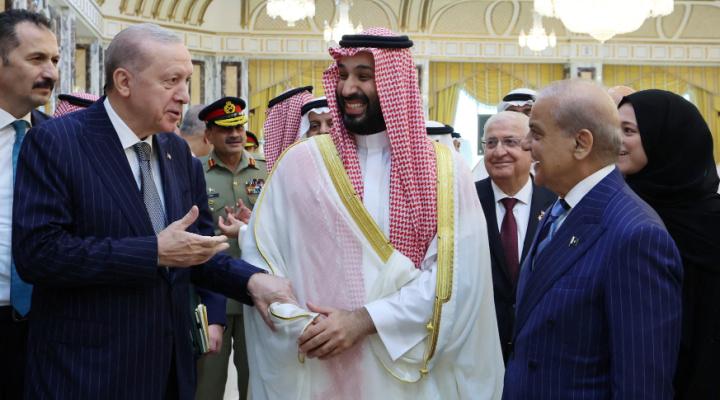
Turkish President Tayyip Erdogan, Saudi Crown Prince Mohammed bin Salman, and Pakistan’s Prime Minister Shehbaz Sharif chat after signing a joint defense agreement in Mecca, Saudi Arabia, Aug. 7, 2026. Photo: Murat Cetinmuhurdar/Turkish Presidential Press Office/Handout via REUTERS
The new Saudi-Turkish-Pakistani defense pact, dubbed a “Muslim NATO,” has triggered warnings in Jerusalem, with a senior official saying the alliance is “aimed at Israel,” while Israeli experts told The Algemeiner that, while troubling, the pact is largely declarative in nature and unlikely to amount to a meaningful military alliance.
“The agreement worries us. This is an alliance aimed against Israel,” a senior Israeli official told the Ynet news site.
Yisrael Beytenu leader and former defense minister Avigdor Liberman also warned of what he called “the new Sunni alliance of Pakistan, Turkey, and Saudi Arabia,” casting the pact as another sign of Israel’s deteriorating regional position and blaming the Benjamin Netanyahu-led government for allowing that to happen.
Signed in Mecca last week, the agreement says an armed attack on any one of the three countries will be considered an attack on all, while setting out plans for closer political and military coordination, joint exercises, and expanded defense cooperation. The three governments have stressed that the pact is defensive and not directed at any particular country, although it is widely seen as being driven in large part by concerns over Iran and its regional proxies.
Prof. Eitan Shamir, director of the Begin-Sadat Center for Strategic Studies at Bar-Ilan University, said the pact was “not a good development from our perspective,” but stressed that it did not pose an immediate threat to Israel.
“At this stage, I see it as more declarative than substantive,” Shamir told The Algemeiner, comparing it to previous defense agreements among Arab states that carried sweeping commitments on paper but had little practical effect.
Saudi Arabia faced hundreds of Iranian missiles and drones following the outbreak of the US-Israel war with Iran on Feb. 28, including attacks targeting Riyadh and a major air base hosting US forces, while the Iran-backed Houthis in Yemen have since resumed missile and drone attacks on the kingdom and its oil infrastructure.
Yet Shamir said he remained skeptical that the pact would translate into an automatic military response to such attacks. “I still don’t see Turkish soldiers charging at the Houthis or the Iranians because some missile landed in Saudi Arabia,” he said.
Shamir said that while Iran was an obvious factor behind the pact, despite the signatories’ assurances otherwise, the more significant message was directed at Washington.
“It is also a message to the US. If Washington leaves a vacuum, or cannot protect Saudi Arabia, other [security] arrangements will emerge,” he said.
The warning is notable because US President Donald Trump had spent much of the past year deepening Washington’s ties with Riyadh. In November, he and Crown Prince Mohammed bin Salman signed a Strategic Defense Agreement that the White House said affirmed the US as Saudi Arabia’s “primary strategic partner,” alongside plans for F-35 sales and hundreds of American tanks. But the Iran conflict has since exposed the limits of that protection, while Trump’s separate effort to tie a civilian nuclear deal to Saudi normalization with Israel has stalled over Riyadh’s refusal to join the Abraham Accords without a clear “pathway” toward Palestinian statehood.
Asher Fredman, executive director of the Misgav Institute for National Security, similarly said the pact was likely to have “little substantial military impact,” pointing out that Saudi Arabia and Pakistan already signed a mutual defense agreement in September 2025 that failed to deter subsequent attacks by Iran and its proxies. He added that the three countries’ interests remain far from fully aligned. Saudi Arabia, he said, “will not go along with [Turkish President Recep Tayyip] Erdogan’s goal to reestablish Ottoman influence in the Middle East,” while Riyadh’s trade with India is eight times its trade with Pakistan, which for decades has been India’s chief rival.
Fredman agreed with Shamir’s assessment that the pact was also a “signal to the US that these countries did not intend to rely entirely on or align” with it. But he said that beyond potentially leading to more military sales and joint exercises, the Mecca agreement was unlikely to supersede their existing defense relationships with Washington.
“Ultimately the US is a far more important military and defense partner to each of these countries,” he told The Algemeiner.
Fredman said the pact could still benefit Israel if it prompted the three countries to take a tougher stance against Tehran.
“If it does lead these countries to take a stronger and bolder stance in the face of Iranian aggression and attacks, that would be a positive development,” he said, though he considered that “unlikely given their recent record.”


