


The Jewish History of Prague (PART TWO)
Error: Contact form not found.

 by Menachem Levine


Tombstones are seen at the Old Jewish Cemetery in Prague, Czech Republic, April 20, 2020. Photo: Reuters / David W Cerny.
Part One of this article appeared here.
The Thirty Years War
The devastation of the Thirty Years’ War (1618-1648) brought mixed fortune for the Jews of Prague. On the one hand, Emperor Ferdinand II, desperate for economic support in the war, took great pains to ensure the safety of the Jews. Although his troops ransacked Prague after the Battle of White Mountain, the emperor prohibited them from harming the Jewish Quarter and even had guards posted outside their homes. To the Jews of Prague, this was nothing short of a miracle. To commemorate this momentous event, they established the 14th of the Hebrew month of Cheshvan – the day the invasion began – as a Purim of Prague.
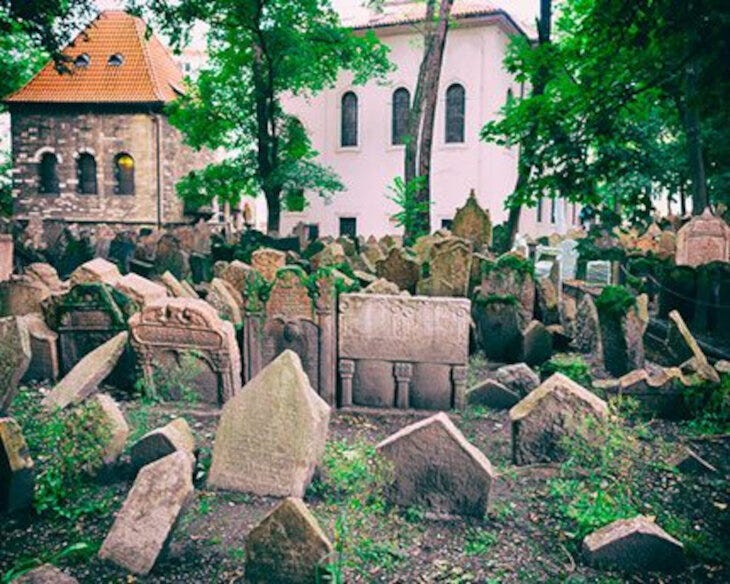
The Jewish Cemetery of Prague
The representative of Prague’s Jewish Community during the Thirty Years’ War was the financier Ya’akov Bassevi of Treuenburg (1570–1634). He was also the first Jew knighted in Europe.
Yet, as his financial needs increased, Ferdinand II made the continuation of Jewish privilege dependent on the Jews’ paying higher taxes and on providing the emperor with a loan of 24,000 gulden. It was these tax requirements that, in 1627, led some resentful Jews to turn on their great Rabbi Yomtov Lipman Heller, who was forced out of Prague and eventually settled in Cracow.
Difficult Times for the Jews of Prague
After the Thirty Years’ War, measures were taken by the state authorities to reduce the number of Jews and to segregate them more strictly in a ghetto. Implementation of these measures was prevented in 1680 by an outbreak of plague, which took the lives of more than 3,500 Jews.
To prevent further Jewish population growth, Emperor Charles VI (1711–1740) issued the cruel Familiants Law in 1726 and 1727. The Familiants Laws decreed that only 8,541 Jewish families would be tolerated in Bohemia and 5,106 in Moravia. Only the eldest son in a Jewish family would be given the right to marry. All other sons were forced to emigrate, try to marry illegally in the countryside, or die single. This would have a devastating effect on Bohemian Jewry for the next 120 years. This legislation remained in effect up to the Revolution of 1848.
The position of the Jews under Emperor Charles VI was even worse when his daughter, Maria Theresa, became empress in 1740. Empress Maria Theresa, an ardent Catholic and antisemite, accused the Jews of siding with the Prussians during her battles for the “Hapsburg Heritage.” She decreed the expulsion of the Jews from Bohemia in 1744 and Moravia in 1745. Although the Prague City Council opposed the action, the Jews were forced out of Prague during a severe winter in January 1745. For a few years, they were permitted to remain in Bohemian villages at least two days’ distance from Prague.
But Empress Maria Theresa had not counted on the devastating effect this would have on Prague’s economy. Jews had been moneylenders, suppliers of raw materials, and good customers in Prague markets. Without the Jews, the economy was in shambles.
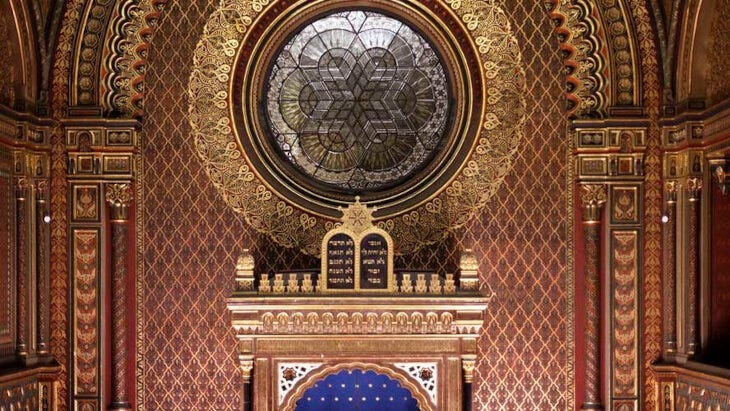
Interior of the Spanish Synagogue
In 1748, the empress rescinded her decree, and Jews were permitted to return to Prague. To avoid humiliation, she imposed a severe annual “toleration tax” of 204,000 guldens on the Jews for the privilege of residing in Prague.
Despite the persecution, Jewish scholarship in Prague continued to flourish. Among the prominent rabbis in the 18th century were Rabbi Eliyahu Spira, Rabbi Dovid Oppenheim, and the Noda b’Yehuda, Rabbi Yecḥezkel Landau.
The Reign of Emperor Josef II and the Edict of Tolerance
Whereas Empress Maria Theresa’s view on the Jews was to expel or convert them, her son, Josef II, viewed the Jews as beneficial to the country. He was focused on building the economy and a modern state with the help of the Jews. He also planned to give increased rights to all non-Catholics, with the vision of creating a strong centralized and united country.
After his mother died in 1780, Emperor Josef II began implementing his more liberal views. However, there were strong reactions from his populace. Some agreed with the emperor in support of Jewish emancipation. Others vehemently opposed, publishing pamphlets depicting the Jews as traitors who murdered Christians and would eventually destroy the monarchy.
In response, Josef II ultimately modified his more ambitious plans.
In October 1781, Josef II issued the Edict of Tolerance for the Jews of Bohemia, and in 1782 for Moravian Jewry. Although it was not a declaration of equal rights, the Edict of Tolerance gave Jews their first opportunity to enter the larger world. The Jews appreciated Joseph II so much that they named the Jewish Quarter, Josefov, after him, and this name still exists today.
There are several points to stress about the Edict of Tolerance. This was not a Civil Rights Act. Although Josef II boasted that his edict granted the Jews “near-equality,” in truth, this was an exaggeration.
The edict did state that Jews no longer had to wear special identifying marks. Yet, the edict continued to deny citizenship to the Jews and forbade them from becoming master craftsmen. The Familiants Law was upheld. Jews continued to be confined to the ghetto until 1849, and complete emancipation would come only in 1867.
As part of its goal to integrate the Jews into the state’s economy, the edict set requirements that essentially decreased the Judaism of the Jews. The use of Hebrew in all business documents and secular transactions was forbidden. Universities were open to Jews, and Jews were encouraged to start factories and engage in agriculture, although they were still forbidden to own land. Jews were also strongly encouraged to close their exclusively Jewish schools, and open new schools that included secular studies.
The emperor was most candid in his observation that the purpose of the edict was “to make [the Jews] useful to the state.”
Subsequent decrees continued to send Jews down the road of integration and assimilation. In 1784, the authority of the beis din (Jewish court of law) was abolished except in religious and marital matters, and disputes were required to be tried in secular courts. In 1786, a law decreed that only graduates of secular elementary schools would be permitted to marry. In 1787, Jews were required to adopt German surnames. With restrictions placed on their Jewish language, education, communal authority, and even names, the Crown felt that Jews would be more integrated and more valuable to the economy of the monarchy.
The Impact of the Edict of Tolerance on the Jews
From the earliest signs of emancipation, debates have raged about whether the reforms were good for the Jewish community or the beginning of its destruction.
On the one hand, the state of constant persecution was devastating. On the other hand, with integration encouraged and demanded from the outside, Jewish identity faced a challenge from which it would never quite recover. Ironically, Jews had survived as a nation and maintained their unique identity and role through 17 centuries of almost unceasing attacks and expulsions. Yet, when the legal barriers that held them back began to disappear, Jews found that the most successful way to enter European society was to abandon their Jewish heritage. The 19th century ushered in an age of assimilation that had no precedent in Jewish history.
The greatest rabbi in Bohemia in the 18th century, Rabbi Yechezkel Landau (1713-1793), was elected chief rabbi one year after a catastrophic fire in Prague in 1754. He had succeeded in building the Prague Jewish community into one of the most vibrant Jewish communities in Central Europe.
Rabbi Landau foresaw that the Edict of Tolerance would lead the Jews on a path away from the Torah. Despite his concerns, he realized he would have to compromise in the face of the monarchy’s steadfast determination to “educate” the Jews. After he was given a role in planning the schools and was assured that the most radical plans would not be implemented, Rabbi Landau gave the schools his tacit approval
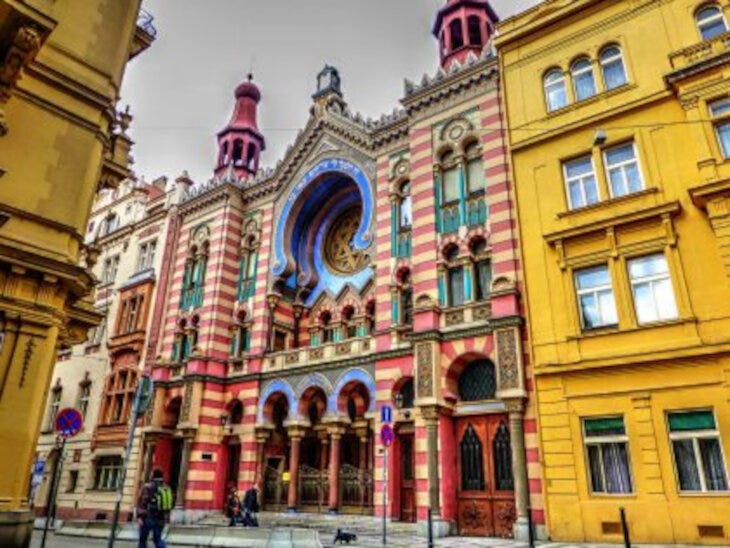
The Synagogue of the Jubilee was constructed outside the old Jewish quarter in the Nove Mesto (New City), in 1905-06, celebrating the integration of Jews into Prague society at the beginning of the century.
Jewish emancipation was a gradual process. The ghetto was abolished in 1852, and Josefov became a district of Prague. In 1852, Jews were allowed to own property, and in 1859, to own land. Unfortunately, Rabbi Landau’s concerns were well-founded. Most of Prague’s Jews had assimilated in the aftermath of the emancipation decrees. By 1930, Prague had a 30% intermarriage rate, one of the highest in all of Europe.
Prague During the Holocaust
In the late 1930s, Jewish refugees escaping the Nazis fled to the Prague area from Germany, Austria, and Sudetenland. Whereas in 1930, 35,463 Jews were living in Prague, there were nearly 55,000 Jews there in 1940.
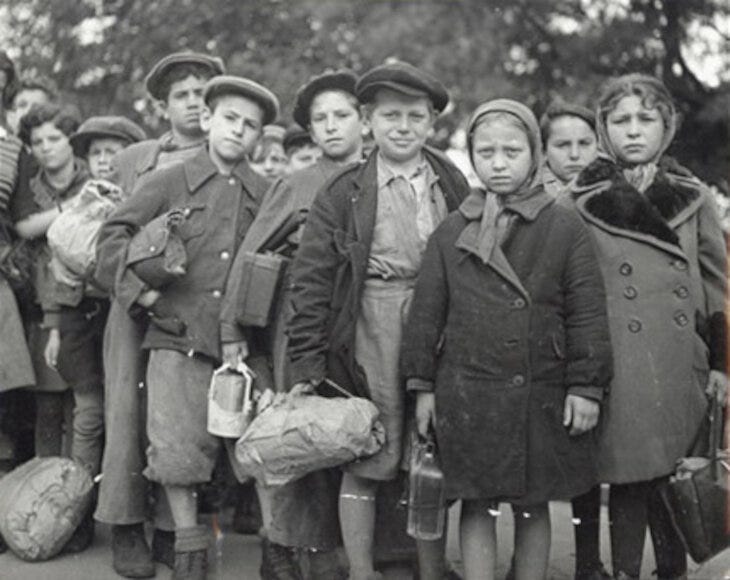
Polish Jewish children, many of whom are orphaned, en route to safety in American Zones of Austria and Germany. Prague, Czechoslovakia. c. 1946. (JDC Archives)
On March 14, 1939, Slovakia declared independence from Prague and signed the Treaty of Protection with Nazi Germany. The next day, Germany occupied the Czech lands. At the outbreak of World War II, Prague was one of the largest Jewish communities in Europe. At the end of the war, two-thirds of the Jewish population of Prague had been murdered in the Holocaust. Over 97,000 Czech Jews perished in the Holocaust, of which 15,000 were Czech Jewish children.
Despite the destruction wrought by the Nazis on the Jews and their community, much of Prague’s Jewish architecture remains. How did these buildings of the Jewish Quarter manage to survive? It is believed that Hitler wanted to establish a “Museum of an Extinct Race” in Prague once the war was over. He had hundreds of thousands of Jewish artifacts transported to Prague from all over Europe.
Post-World War II
In 1945, the Communist Party took power, and in the coming decades, Jewish life was stifled, and emigration to Israel was forbidden as of 1949. Jews who remained in Prague kept their Jewish identity a secret.
In 1968, a Slovak Communist named Alexander Dubcek became the party leader. During the Prague Spring, he began introducing sweeping reforms to make the government more democratic. He ordered an end to censorship and encouraged open discussion about the political direction of Czechoslovakia. Many young Jews were involved in the events of the Prague Spring. Additionally, for the first time since World War II, they were able to openly ask questions about the Holocaust and their Jewish heritage.
The Soviet Union disapproved of these changes and invaded Czechoslovakia in August 1968. Civilians were shot dead in the street, and 3,400 Jews fled the country. The secret police kept a close eye on the remaining Jewish community, and many Jewish university professors lost their jobs. From 1968 to 1989, the Holocaust was forbidden to be mentioned, and survivors were required to be silent on the topic.
The End of Communism and a New Reality
When change began to sweep through Eastern Europe in the late 1980s, Czechs joined the movement. Demonstrations led to the resignation of the Communist Party leadership in November 1989. Alexander Dubcek, the Prague Spring reformer, was elected chairman of parliament. In June 1990, the country held its first free election since 1946. On January 1, 1993, the country split into the Czech Republic and Slovakia. Prague was adopted as the capital of the Czech Republic.
Today, the Federation of Jewish Communities estimates that there are between 3,000 and 5,000 Jews in the Czech Republic, of which 1,600 live in Prague.
The beauty of Prague’s Jewish buildings and the old ghetto remain visited by countless tourists. Sadly, Prague, which had been, for a time, the most vibrant, influential and populous Jewish city in the world, has essentially become a museum of testimony to its earlier greatness. Yet, the works produced/ and the Torah taught by its great leaders continue to live on for eternity. They are Jewish Prague’s legacy.
Rabbi Menachem Levine is the CEO of JDBY-YTT, the largest Jewish school in the Midwest. He served as Rabbi of Congregation Am Echad in San Jose, CA, from 2007 to 2020. He is a popular speaker and writes for numerous publications on Torah, Jewish History, and Contemporary Jewish Topics. Rabbi Levine’s personal website is https://thinktorah.org This article was originally published at Aish.


