The Jewish History of Prague (PART ONE)
Error: Contact form not found.

 by Menachem Levine


The Czech Foreign Ministry building in Prague. Photo: VitVit via Wikimedia Commons
Historically, Prague was the capital of Bohemia and is today located in the Czech Republic. Jewish life in Prague has been documented as early as 970 CE.
Jewish merchants at Prague markets are mentioned in a report by the Jewish merchant Abraham ibn Jacob of Córdoba. By the end of the 11th century, a Jewish community had been fully established in Prague.
In 1096, the community was attacked by Crusaders, and hundreds of Jews were murdered. The community as a whole was again attacked during the siege of the Prague Castle in 1142, when the oldest synagogue in Prague and sections of the Jewish Quarter were burned down.
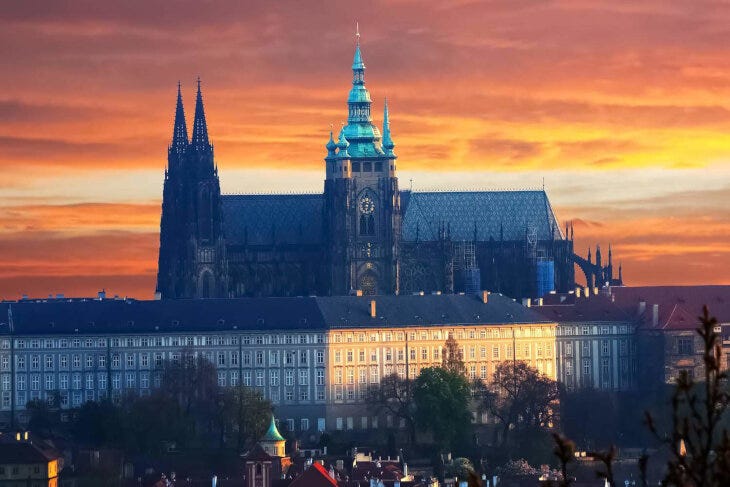
Prague Castle
After the siege, Jews were required to live on the right bank of the Vltava in an area that eventually became Prague’s Jewish ghetto, the Josefov. During this time, Jews were very limited in their movements. By day, the doors to the ghetto were open, but in the evening and on festivals, the gates of the ghetto were locked.
The situation did not improve in the early 13th century. In 1215, the Fourth Lateran Council mandated that Jews wear distinctive clothing, prohibited them from holding public office, and limited the amount they could charge on loans. Catholic antisemitism was the norm for the Jews of Prague.
Tug of War Between Rulers and Church
Things began to change at the end of the 13th century under King Otakar II. He issued a Royal Charter in 1254, which stated that the Jews were protected as moneylenders and servants of the king and were required to pay high taxes and occasionally supply loans to the royal treasury. More importantly, regarding the prevalent Christian antisemitism, the Royal Charter protected the Jews from persecution. It refuted the blood libel myth; prohibited violence against Jews, their property, synagogues, and cemeteries; and outlawed all forced baptisms in the kingdom.
The Church was furious at this infringement of its power and filed complaints against King Otakar II. The king disregarded their complaints and defended his charter by stating that the Jews were official servants of his treasury and thus fell under his control and protection. This conflict between the church and nobility would continue for centuries over the status of the Jews and their possessions.
Life for the Jews in Prague flourished, with Jewish scholarship and prosperity in the community. In the immediate aftermath of the Royal Charter, the Jewish Quarter was established as an autonomous district in which Jews were permitted to govern most of their internal affairs. The Altneuschul – the oldest remaining shul in Europe today – was built in 1270. Jewish life would center around this beautiful building; for many, it represented the unity of the Jews of Bohemia.
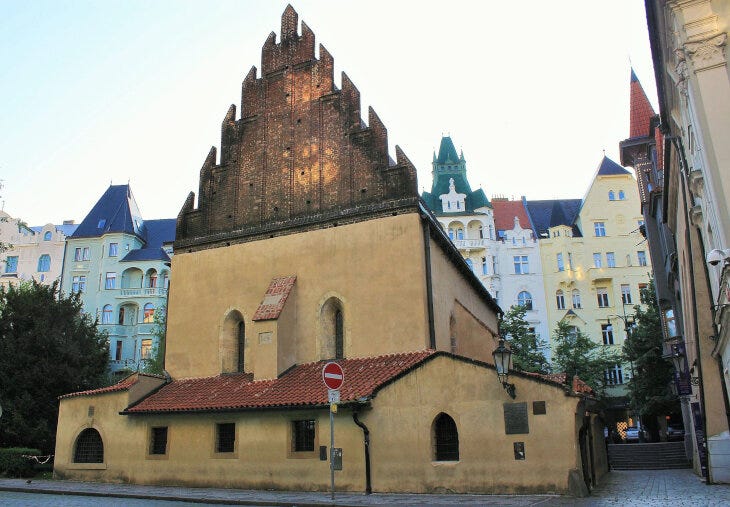
The Altneuschul – the oldest remaining shul in Europe today
Some of the most outstanding Jewish leaders resided in Prague at this time. At the beginning of the 13th century, the Jewish community was led by Rabbi Avraham ben Azriel, well known for his work Arugas Habosem. His student was the famous Rabbi Yitzchak ben Moshe, also known as the Or Zaru’a after the title of his most famous work, a significant commentary on the Talmud.
King Charles IV ruled from 1356-1378. He used the Jews to benefit his treasury, at times granting them rights if that were useful for him, and at other times, using their misfortune for his gain. In 1357, he canceled all debts owed to the Jews of his lands to appease his noblemen and strengthen his rule.
[This act of canceling non-Jewish debt owed to Jews was especially popular in Europe, as the Jews were the established moneylenders of the continent. Historically, this reality existed through coercion, not by choice. Christian law forbade taking interest, yet loans were necessary to fund wars and government projects, so the church required Jews to take the role of moneylending. Since Jews were also forbidden by law to serve in most other professions – including medicine, owning property, and as artisans – this was one of the only fields remaining to them. It was a profession wrought with danger, as it was very appealing to cancel debts owed to Jews by murdering or expelling them, or having the government cancel all debts to Jews, as King Charles IV did in 1357.]
One of the most prominent Jews in Prague at the time was a man by the name of Lazar. In gratitude for his frequent loans to the royal treasury, he was granted a tax amnesty from 1350 to 1352. The most significant sign of Lazar’s influence was that he was granted the privilege of living outside the Jewish Quarter. After the death of Lazar, Charles IV claimed his home for one of the first sites of Charles University, the oldest university in Central Europe.
As was so often the case for the Jews of Europe, there were times of stability and times of horrific antisemitism. Jews knew not to get too comfortable, for history had shown them that expulsion or attacks could be just around the corner.
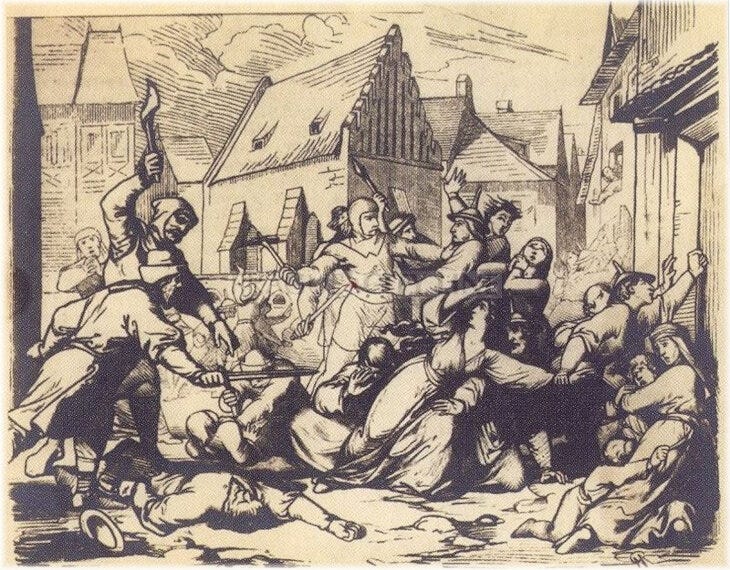
Deadly Easter pogrom in Prague, 1389
Prague was devastated by a pogrom in 1389. On Easter that year, which coincided with Passover, Jews were accused of “vandalizing the eucharistic wafer” and, as a result, 3,000 Jewish men, women, and children were cruelly murdered in the streets, homes, and synagogues of the ghetto. One of the few survivors, the great Torah Scholar Rabbi Avigdor Kara (whose tomb is preserved in the Old Jewish Cemetery), saw his father murdered. He wrote a moving prayer, “Es kol ha-tela’ah,” describing the attack, which is read yearly in Prague on Yom Kippur. In the aftermath of the pogrom, many Jews fled Prague for Poland and Hungary.
Life Under the Hussites
The situation for Prague’s Jews fluctuated throughout the 15th century, but there was a brief respite from Catholic persecution under the Hussites.
The Hussites were Bohemian religious separatists who followed the teachings of Jan Hus, a preacher who was burned at the stake in 1415 for criticizing the corruption of the Church. From 1419 to 1436, the Hussites waged war to attempt to gain sovereignty in the Kingdom of Bohemia. During their battles, they protected the Jews against persecution by the Church.
The Hussites were fascinated by the Jews and regarded the Jews as their allies, especially since they shared the common experience of suffering caused by the Church. The Jews, for their part, helped the Hussites in building fortifications at the castle of Vysehrad in 1420. Yet, despite the significant improvements, life under the Hussites was not all bliss. During their reign, pogroms erupted in Prague in 1421 and 1422, leading many Jews to flee to Poland.
More Persecution and Expulsion
An unforeseen consequence of the Hussite wars was the weakening of royal power in favor of the nobility. As a result, Jews in the 15th century could not be as sure of the king’s ability to protect them and ended up paying tax money to as many as three different administrations. In much of Moravia and Bohemia, Jews were expelled at the whims of the local governments. Generally, the situation was different in Prague. As long as the tax revenues kept flowing, Jews lived in relative peace.
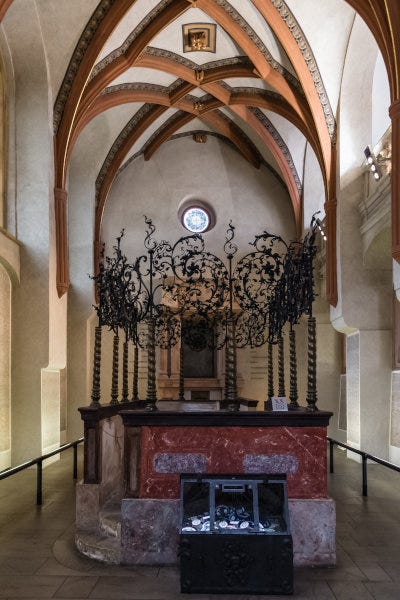
The Pinchas Synagogue was first built for the Horowitz family
The 16th century became known as the age of the Prague Renaissance. Artisans and intellectuals came from all over Europe and assembled in Prague.
The Jewish population also increased, and between 1522 and 1541, the Jewish population of Prague almost doubled. Many Jewish refugees expelled from Moravia, Germany, Austria, and Spain came to Prague. During this period, the ghetto expanded, and Jews were permitted to acquire lands adjacent to the ghetto to build homes. The Jewish Quarter officially became the ghetto, though this was not marked by any known legislation.
In 1541, a struggle between Ferdinand I and the Burghers resulted in a Burgher demand that Jews be expelled from Prague, and Ferdinand I expelled the Jews for two years. Another temporary removal of the Jews of Prague took place in 1557. Following Ferdinand’s death in 1564, the situation improved for Prague Jewry.
The Golden Age of Prague was primarily during the reigns of Maximilian (1564-1576) and Rudolf II (1576-1612). Emperor Rudolf II was considered a weak leader by the Catholic world because he devoted much energy to the arts and sciences.
In 1584, Emperor Rudolf II moved his imperial seat and residence to Prague, which led to an economic and population boom in his new capital.
Under his rule, the Jews were permitted economic and religious freedom. He promised Jews permanent safety in Prague and Bohemia and issued decrees protecting the Jews from the hostility of the noblemen. He permitted Jews to become artisans and ensured that the royal court judged all disputes between Jews and Christians. In 1599, Rudolf II even exempted the Jews from all city taxes. Due to these economic policies, the Jews of Prague could finally branch beyond moneylending and support themselves through other means.
During the Golden Age of Prague, the community grew to over 3,000 by the end of the 16th century and over 6,500 by the end of the 17th century. Due to the favorable situation, Jews from around the world came to settle in the Jewish Quarter, and some of the most outstanding Jewish leaders of Europe lived in Prague at the time.
Great Jewish Leaders of Prague
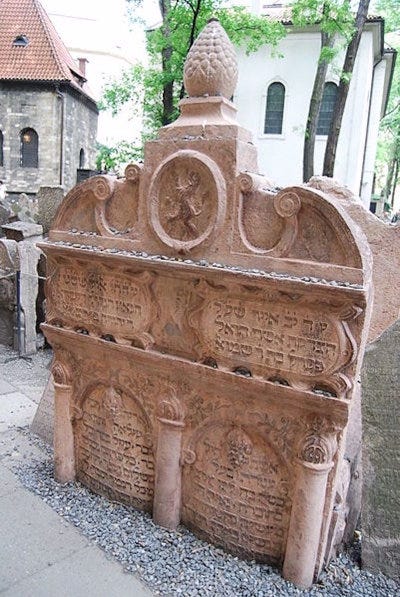
Tombstone of the Maharal in the Old Jewish Cemetery, Prague (Photo: Wikimedia)
The Maharal, Rabbi Yehuda Loew, was the chief rabbi of Prague. He was a towering giant in Torah and Kabbalah and a fearless leader of European Jewry during the 16th century. He is known for his works on Jewish philosophy and for the Gur Aryeh al HaTorah, a super-commentary on Rashi. The Maharal was also an outstanding rabbinic leader and established the guidelines for Prague’s first Chevra Kadisha (Jewish Burial Society). He published more than 50 religious and philosophical books and became the center of legends as the mystical miracle worker who created the Golem. (Whether the Golem actually existed or not is unclear, but the greatness of the Maharal is entirely independent of the Golem story.) The Maharal had positive relations with Rudolph II and was invited to his castle on occasion.
The Maharal’s great students were the next generation’s leaders, among them the Kli Yakar (Rabbi Efraim Shlomo ben Aharon of Luntshits), the Tosfos Yom Tov (Rabbi Yom Tov Lipmann Heller), Rabbi Shabtai Sheftel ben Akiva Horowitz, and the Shelah (Rabbi Yeshayah ben Avraham Horowitz).
Another well-known Jewish figure of the time was Rabbi Dovid Shlomo Ganz (1541-1613), a mathematician, historian, and astronomer. He corresponded with royal court astronomers Tycho Brahe and Johannes Kepler. Rabbi Ganz was a student of both the Rema, Rabbi Moshe Isserles, and the Maharal. He wrote multiple works on the Torah, the most well-known of which is his Tzemach David, published in Prague in 1592. The book is divided into two parts: The first is an accounting of Jewish history, and the second part is general world history.
Mordechai Maisel (1528–1601) was Rudolf’s court Jew and banker and helped him finance a war against Turkey. He was a brilliant financier and an outstanding philanthropist for his people. He funded buildings for the Jewish community, including numerous synagogues and mikvahs. He paid to pave the muddy paths of the ghetto with cobblestones. Not only did he contribute money to Prague causes, but he also donated Torah scrolls to Jewish communities worldwide, including Jerusalem.
Rabbi Menachem Levine is the CEO of JDBY-YTT, the largest Jewish school in the Midwest. He served as Rabbi of Congregation Am Echad in San Jose, CA, from 2007 to 2020. He is a popular speaker and writes for numerous publications on Torah, Jewish History, and Contemporary Jewish Topics. Rabbi Levine’s personal website is https://thinktorah.org This article was originally published at Aish.