




Israel Sees Major New Diplomatic Gains in Latin America
Error: Contact form not found.

 by Ailin Vilches Arguello

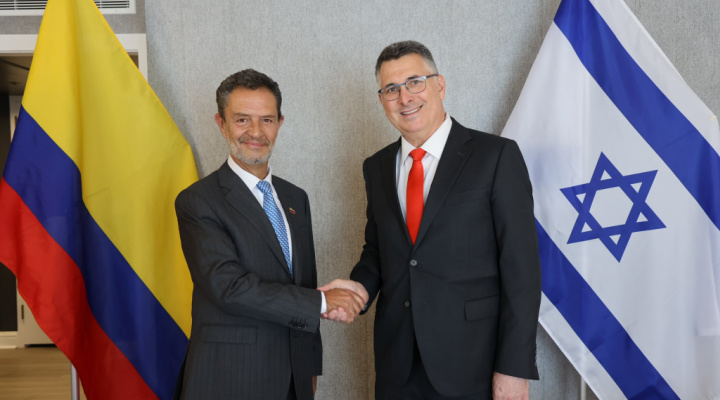
Israeli Foreign Minister Gideon Saar meets with Colombia’s incoming Foreign Minister Omar Bula in Washington, where the two sides agreed to restore diplomatic and economic ties after years of strained relations. Photo: Screenshot
Israel this week has notched big diplomatic wins in both Colombia and Venezuela, continuing a wave of momentum across Latin America, where several countries have recently boosted ties with the Jewish state following years of strained relations.
The governments of Venezuela and Israel announced on Tuesday that they agreed to restore consular services in each country and establish an official coordination channel. The move, which came after Venezuela ended relations with Israel in 2009, followed an Israeli humanitarian delegation visit to the country in the aftermath of deadly earthquakes there in June.
“The two countries have agreed to continue their bilateral technical cooperation stemming from the emergency response and reconstruction efforts following the double earthquake,” the joint statement said. “The two countries have also agreed to establish a coordination mechanism that will enable the provision of consular services, as needed, to their citizens residing in the other country.”
“The two governments recognize the importance of the relationship between the State of Israel and the Jewish community residing in the Bolivarian Republic of Venezuela, which serves as an important bridge of historic friendship between the two countries,” it continued.
Dr. Miguel Truzman, national coordinator of the Confederation of Jewish Associations of Venezuela, touted the development as the beginning of a “new era” in bilateral relations.
“After 17 years without consular relations, Venezuela and Israel are advancing in a confidence-building process that began with the various Israeli and Jewish organizations that came to Venezuela on the occasion of the double earthquake that struck the country on June 24, and which on that occasion provided great technical and humanitarian aid in the face of the tragedy and devastation,” he said in a statement.
“Today, a new era begins, taking a first step in the Consular area, as technical support in the areas required, and in the near future, diplomatic relations between both nations will be fully restored.”
One day earlier, Colombia on Monday recognized Israeli sovereignty over the Golan Heights, becoming only the second country in the world after the United States to formally endorse Israel’s claim to the strategic territory, in a major foreign-policy shift by the country’s new government aimed at restoring close ties and expanding its partnership with the Jewish state.
Just days after the inauguration of newly elected right-wing President Abelardo de la Espriella, the new administration announced that Colombia recognizes Israel’s sovereignty over the Golan Heights, a strategically vital mountainous region captured from Syria in 1967 that commands a critical position along Israel’s northern frontier.
Following the fall of long-time Syrian President Bashar al-Assad in 2024, Israel deployed troops into a buffer zone along the Syrian border to establish a military position aimed at preventing terrorists from launching attacks against the Jewish state.
The previously demilitarized zone in the Golan Heights was established under the 1974 Disengagement of Forces Agreement between Damascus and Jerusalem that ended the Yom Kippur War. However, Israel considered the agreement void after the collapse of Assad’s regime.
“Given the persistent regional instability in the Middle East and considering the strategic importance of the Golan Heights to Israel’s security, the Government of Colombia recognizes Israeli sovereignty over this territory, as well as Israel’s right to protect itself against external threats,” Colombia’s Foreign Ministry said in a press release.
“In this regional security context, Colombia recognizes that maintaining Israel’s control and sovereignty over the Golan Heights is an essential component of its national defense and its ability to protect and safeguard its citizens,” the statement continued.
Israeli Foreign Minister Gideon Sa’ar welcomed the announcement as a “historic decision,” praising Espriella for taking the step so early in his presidency and highlighting it as a powerful demonstration of Colombia’s renewed commitment to Israel and its security.
“With this decision, the president of Colombia has demonstrated, in one of his first decisions in office, his leadership, his values and his commitment to Israel and its security,” the top Israeli diplomat wrote in a post on X.
“Israel is a small country without strategic depth. Having defensible borders is essential for Israel in order to ensure the existence of the Jewish people in their historic homeland,” Sa’ar continued.
Agradezco a Colombia y a mi buen amigo, el presidente de Colombia, Abelardo De La Espriella @ABDELAESPRIELLA, por su histórica decisión de reconocer la soberanía de Israel en los Altos del Golán.
Esto, tras nuestra reunión en Barranquilla, Colombia, el pasado jueves.— Gideon Sa’ar | גדעון סער (@gidonsaar) August 10, 2026
The announcement came just days after Sa’ar traveled to Colombia to attend Espriella’s inauguration, underscoring the rapidly warming relationship between the two countries after the new government pledged to restore close ties with Israel following years of diplomatic deterioration under former left-wing President Gustavo Petro.
During his diplomatic visit to Colombia last week, the top Israeli diplomat met with several of the country’s newly appointed cabinet ministers as part of talks with Colombian Vice President Jose Manuel Restrepo in Cali, the capital of the southwestern Valle del Cauca.
With Colombia’s new administration taking office, Bogotá has pledged to fully restore bilateral relations with Israel, deepen cooperation across key sectors, and reverse years of diplomatic tensions under Petro, whose anti-Israel policies and rhetoric severely strained one of Latin America’s historically closest partnerships with the Jewish state.
Last month, Sa’ar met with his Colombian counterpart in Washington, where the two sides agreed to fully restore diplomatic and economic ties, exchange ambassadors, and scrap mutual visa requirements, laying the groundwork for a renewed strategic partnership.
Colombia’s new government has also pledged to withdraw the country’s support for South Africa’s contentious genocide case against Israel at the International Court of Justice (ICJ).
Under Espriella’s administration, Bogotá also intends to open an embassy in Jerusalem — a move recognizing the city as Israel’s capital and marking a major shift in the country’s foreign policy toward the Jewish state.
Historically, Colombia has been among Israel’s closest partners in Latin America, maintaining strong security, economic, and diplomatic cooperation for decades. However, relations deteriorated sharply under Petro, who filed a declaration of intervention in South Africa’s case in April 2024 and severed diplomatic ties with Israel the following month over the war in Gaza.
Across Latin America, several governments moved to downgrade or sever diplomatic ties with Israel following the outbreak of the war in Gaza, as part of broader efforts to pressure and isolate the Jewish state over its defensive military campaign against the Palestinian terrorist group Hamas.
Now, a broader geopolitical shift is unfolding across Latin America, as a growing number of conservative governments seek closer ties with Israel, allowing the Jewish state to build on this emerging momentum by expanding cooperation, strengthening alliances, and deepening bilateral relations throughout the region.
Last week, Chile and Honduras officially restored full ambassadorial representation with Israel, marking a major diplomatic breakthrough and the return of full bilateral ties for the first time since the Hamas-led invasion of and massacre across southern Israel on Oct. 7, 2023.
This growing momentum in Israel’s relations with Latin America builds on the expanding reach of the Isaac Accords, a framework signed earlier this year by Argentine President Javier Milei and Israeli Prime Minister Benjamin Netanyahu to deepen ties with governments across the region while strengthening cooperation against antisemitism and terrorism.
Modeled after the Abraham Accords — a series of historic, US-brokered normalization agreements between Israel and several Arab countries — the new initiative aims to deepen political, economic, and cultural ties between the Jewish state and Latin American governments, with expanded cooperation in technology, security, innovation, trade, and economic development as countries across the region work together to address shared security challenges.
The Isaac Accords also seek to institutionalize expanding cooperation with Latin American partners through enhanced intelligence-sharing, security coordination, and joint law enforcement efforts targeting Iranian proxy networks and transnational criminal organizations operating across the hemisphere.