




Trump Administration Drops Requests for Private Data on Jewish University of Pennsylvania Faculty

 by Dion J. Pierre


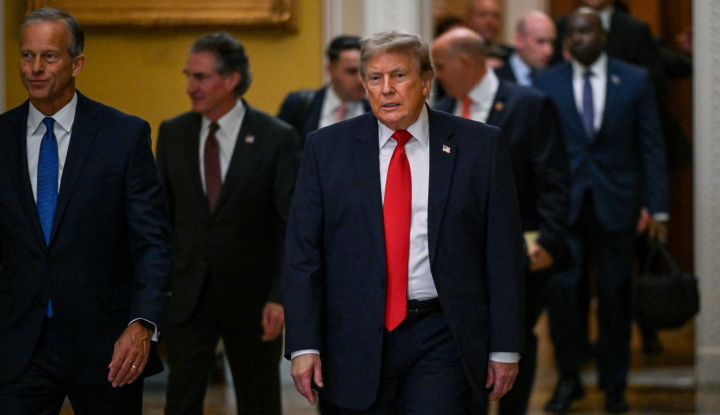
US President Donald Trump walks with Senate Majority Leader John Thune (R-SD) to the Senate Republican Steering Committee lunch at the US Capitol, in Washington, DC, US, June 24, 2026. Photo: REUTERS/Annabelle Gordon
The Trump administration has withdrawn a federal subpoena seeking personal contact information for Jewish employees at the University of Pennsylvania (Penn), ending a months-long legal battle that exposed divisions within the Jewish community over the administration’s campaign against campus antisemitism.
Under a resolution agreement filed Thursday with the US Court of Appeals for the Third Circuit, the Equal Employment Opportunity Commission (EEOC) said it would no longer attempt to enforce the subpoena or obtain any information Penn had not already produced in response to it. Penn, in exchange, agreed to dismiss its appeal of a lower-court ruling that largely upheld the agency’s demands.
“The EEOC warrants that it will not take any further measures to enforce the subpoena seeking identification and personal contact information” from Penn employees, the agreement said.
The agreement ends the dispute over the subpoena but does not terminate the EEOC’s broader investigation into alleged workplace antisemitism at Penn. The agency could still pursue other investigative measures or take legal action against the university.
EEOC Commissioner Andrea Lucas launched the investigation in December 2023, alleging that Penn may have subjected Jewish employees to a hostile work environment. In July 2025, the agency issued a subpoena seeking the names of employees who had reported antisemitic harassment, along with private contact information for employees affiliated with Jewish campus organizations or the university’s Jewish Studies Program.
The subpoena also sought contact information for employees who participated in listening sessions on antisemitism or received a university survey on the issue. The EEOC maintained that it needed to communicate privately with potential victims and witnesses without Penn monitoring the exchanges.
Penn provided the government with hundreds of pages of documents but refused to disclose some employees’ names, home addresses, personal telephone numbers, and private email addresses without their consent.
In March, US District Judge Gerald Pappert ordered Penn to comply with much of the subpoena, finding that the EEOC had a legitimate interest in contacting employees who might possess evidence of antisemitic discrimination. He nevertheless ruled that the university did not have to identify any employee’s affiliation with a specific Jewish organization.
Pappert also rejected arguments comparing the subpoena to the compilation of lists of Jews under Nazi rule, calling such analogies “unfortunate and inappropriate.” Employees contacted by the EEOC, he noted, would remain free to decline to participate in the investigation.
Penn appealed the decision, and enforcement of the subpoena was suspended while the case proceeded through the courts.
The dispute generated fierce opposition from some Jewish faculty members and campus organizations, several of which intervened in the case with assistance from the American Civil Liberties Union of Pennsylvania. Hundreds of Penn students, faculty members, staff, alumni, and other affiliates also signed a petition supporting the university’s refusal to disclose the requested information.
“We are deeply concerned by the Trump administration’s lawsuit, which demands that the university compile and provide the names, personal emails, phone numbers, and addresses of Jewish members of the Penn community, including those who have requested that their information not be shared with the federal government,” the petition said.
Penn welcomed the EEOC’s withdrawal, saying none of the disputed personal contact information had been disclosed.
“With the support of many members of the community who have stood with Penn throughout, the University has been able to protect its employees’ rights,” the school said in a statement, while reiterating its commitment to fighting antisemitism and other forms of discrimination.
The episode highlighted a broader division among American Jews over the Trump administration’s approach to campus antisemitism. Many Jewish students and communal organizations have welcomed aggressive federal intervention after universities failed to address anti-Jewish harassment, intimidation, and violence following Hamas’s Oct. 7, 2023, invasion of southern Israel.
Others support investigations into antisemitism but object to tactics they view as excessively intrusive or as part of a broader conservative offensive against universities. Critics have also argued that sweeping funding cuts and other sanctions can damage medical research, academic programs, and students who played no role in campus misconduct.
The contrasting reactions suggest that disagreements within the Jewish community are often less about whether universities should be held accountable for antisemitism than about which legal and political tools the government should use.
In other higher-education news, a federal appeals court on Thursday rejected the Trump administration’s attempt to return a Georgetown University scholar to immigration detention while deportation proceedings against him continue.
In a 2-1 decision, the US Court of Appeals for the Fourth Circuit upheld the release of Badar Khan Suri, an Indian citizen and postdoctoral fellow at Georgetown’s Alwaleed Bin Talal Center for Muslim-Christian Understanding.
Federal authorities detained Suri in March 2025 after accusing him of spreading Hamas propaganda and engaging in activities deemed harmful to US foreign policy. Suri has denied supporting Hamas and argued that the government targeted him because of his pro-Palestinian speech and associations.
The Fourth Circuit ruled that a federal district court had jurisdiction to consider Suri’s claim that his detention violated his constitutional rights. The ruling does not prevent the government from continuing its efforts to deport him.
The decision conflicts with recent rulings involving Mahmoud Khalil and Mohsen Mahdawi, two Columbia University activists who were also detained as part of the administration’s crackdown on foreign nationals involved in disruptive anti-Israel campus activism.
The Third and Second Circuits held that lower courts lacked jurisdiction over similar challenges brought by Khalil and Mahdawi, respectively. The conflicting decisions create a circuit split that could ultimately require resolution by the US Supreme Court.
Follow Dion J. Pierre @DionJPierre.