






‘This is Not Just a Left Issue—it is an American Issue’: Israel’s Favorability Sees Massive Decline Among US Public, Polls Say
Error: Contact form not found.

 by Corey Walker

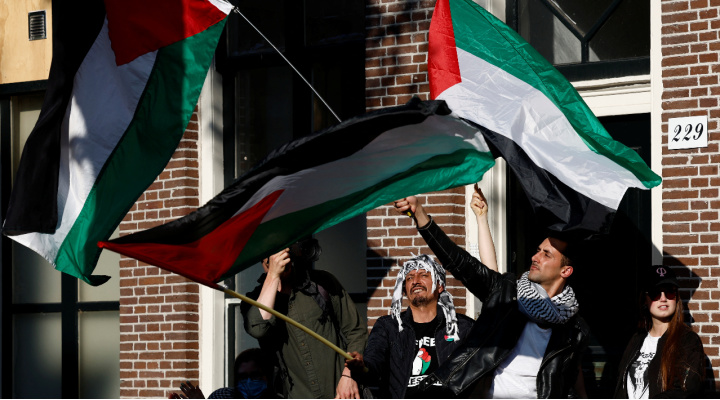
Anti-Israel protesters wave Palestinian flags as students and employees of the University of Amsterdam protest against the ongoing war in Gaza and the university leadership after police broke up a student protest camp overnight, in Amsterdam, Netherlands, May 7, 2024. Photo: REUTERS/Piroschka van de Wouw
US public opinion has shifted dramatically against Israel, according to a series of recently released polls, raising serious questions about the long-term durability of the alliance between the United States and the Jewish state.
The change is no longer confined to progressive activists on the far left or isolationists on the far right. Negative views of Israel are increasingly visible across the broader electorate, including among independents, younger Republicans, and voters both with and without college degrees, the polls show. That represents a marked departure from an era when support for Israel was a durable feature of mainstream American opinion.
Citing surveys from Ipsos, Fox News, Marquette University Law School, the Pew Research Center, and Gallup, CNN chief data analyst Harry Enten said the findings indicate that declining support is no longer confined to one political party or demographic group.
“These are some absolutely huge, mammoth changes, generational changes that we’re talking about,” Enten said in a video segment on the station this past week. “I think there are a lot of Republicans [who think], ‘Oh, we’ll be able to run against these anti-Israeli Democrats once we hit the general election.’”
However, Enten continued, the general electorate no longer differs as dramatically from the Democratic base as Republicans may assume.
“We’re not just talking about the Democratic base anymore,” he said. “The general electorate has turned against Israel. This is not just a left issue. It’s an American issue. The trend line is unbelievable.”
Enten cited a Pew Research Center survey conducted in late March and released in April that found 60 percent of US adults held an unfavorable opinion of Israel, compared with 37 percent who viewed the country favorably. Israel’s net favorability in the poll stood at minus 23 points.
In 2022, by contrast, 55 percent of Americans viewed Israel favorably and 42 percent viewed it unfavorably.
An April survey by Marquette University Law School similarly found that 54 percent of Americans viewed Israel unfavorably and 33 percent viewed it favorably, producing a net rating of roughly minus 20 points. One year earlier, Americans had been evenly divided, with 43 percent holding favorable and unfavorable opinions.
Enten also pointed to Ipsos and Fox News polling that placed Israel’s net favorability at minus 10 and minus 11 points, respectively. The latest Fox News survey found that 44 percent of registered voters viewed Israel favorably, down from 58 percent a decade earlier. Favorable ratings declined during that period among Democrats, Republicans, and independents.
According to Enten’s analysis, Israel’s average net favorability has fallen from approximately positive 51 points during the comparable period of President Donald Trump’s first term in 2018 to about minus 16 points today — a swing of roughly 67 points over eight years.
“Israel used to be a consensus issue in American politics, and that was a pro-Israeli position,” Enten said. “Now the consensus has actually shifted.”
The changing public mood also extends to US policy. Enten cited polling showing that 55 percent of Americans favor reducing or ending US military assistance to Israel. That position was supported by 62 percent of college graduates and 51 percent of voters without college degrees.
The findings suggest that opposition to aid is no longer limited to highly educated progressives or voters participating in Democratic primaries. Even among generally moderate Americans, support for Israel and the US-Israel alliance appears to have weakened.
Other recent polling has illustrated the widening partisan divide. An Associated Press-NORC Center for Public Affairs Research survey conducted in June found that 58 percent of Democrats believed the United States was too supportive of Israel, up from 45 percent in January 2024. Sixty-two percent of Democrats said Washington was not supportive enough of the Palestinians.
Republicans moved in the opposite direction, with 60 percent saying current US support for Israel was about right. However, other polling indicates that younger Republicans are considerably less supportive of the Jewish state than older members of the party.
The shift has been especially pronounced among younger Americans. Pew found that 57 percent of Republicans under 50 now hold an unfavorable opinion of Israel, while large majorities of Republicans over 50 continue to view the country positively.
Among Americans under 30, just 32 percent viewed the Israeli people favorably, compared with 58 percent who viewed the Palestinian people favorably.
A July Harvard CAPS-Harris poll produced an even more striking finding: 60 percent of registered voters aged 18-24 said they supported Hamas over Israel when forced to choose between the two. The result contrasted sharply with the electorate overall, among whom 73 percent chose Israel and 27 percent chose Hamas.
The polling comes as US lawmakers confront a rapidly changing political landscape surrounding Israel and the Middle East. Democratic lawmakers have increasingly adopted adversarial language toward the Israeli government, with a growing number using the term “genocide” to describe Israel’s military operations in Gaza.
Although Republican officeholders remain considerably more supportive of Israel, younger conservatives have shown greater receptiveness to politicians who oppose foreign aid or question the traditional US-Israel relationship.
Taken together, the findings suggest that support for Israel can no longer be assumed to command the broad bipartisan approval it enjoyed for decades. Criticism of the Jewish state has moved beyond the ideological fringes and into the political mainstream, potentially reshaping both parties’ approach to Israel for years to come.


