





The Election That Could Define Israel’s Social Contract
Error: Contact form not found.

 by Daniel Beaudoin


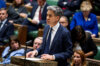
Israeli politicians react following a vote to dissolve the Knesset, Israel’s parliament, before the end of its term, at the Knesset, in Jerusalem, May 20, 2026. Photo: REUTERS/Ronen Zvulun
The final days of a parliament often reveal more about a country’s political priorities than its opening declarations. In Israel, the closing acts of the 25th Knesset may prove to be remembered not for ending a government, but for defining the central question of the election that follows: What does equality of citizenship mean after October 7?
On July 10–11, the Knesset approved two measures that fulfilled longstanding demands of the ultra-Orthodox parties. The first, Basic Law: Torah Study, declares Torah study a fundamental value of the Jewish people and the State of Israel. The second suspends enforcement proceedings against many ultra-Orthodox draft evaders who are recognized as yeshiva students. Together, the laws represent one of the coalition’s final legislative acts before Israelis return to the polls in October.
To supporters, these measures recognize an essential component of Jewish civilization. Torah scholarship, they argue, has preserved Jewish identity through centuries of exile and persecution. Protecting it is therefore not a political concession but a constitutional affirmation of the state’s Jewish character. They further contend that a society under existential threat requires not only military strength but also spiritual continuity, and that Israel has always balanced multiple forms of national service.
Critics see the legislation through a different lens. For them, the issue is not religion but reciprocity. Since the Hamas attacks of October 7, hundreds of thousands of reservists have served repeated tours of duty, many leaving families, careers and businesses behind. Casualties have touched nearly every community. In this context, legislation perceived as reducing military obligations for one sector inevitably raises questions of fairness.
The significance of these laws therefore lies less in their legal wording than in the political symbolism they carry. They crystallize a debate that has been building for years but has acquired unprecedented urgency during wartime: whether citizenship in Israel entails equal obligations as well as equal rights.
The parliamentary vote itself underscored this tension. Several coalition members voted against the legislation or abstained, while Deputy Foreign Minister Sharren Haskel resigned immediately afterward, arguing that the measure harmed both the security of the state and those who had already borne the burden of military service. Such dissent within the governing coalition illustrates that the debate is no longer simply between left and right. It increasingly divides Israelis according to competing understandings of civic responsibility.
Prime Minister Benjamin Netanyahu faced a difficult political calculation. His governing coalition depended upon maintaining the confidence of the ultra-Orthodox parties, for whom protection of Torah students has long been a defining priority. From that perspective, advancing the legislation before dissolving the Knesset was both predictable and politically rational.
Yet politics is rarely only about satisfying one’s existing partners. Every legislative victory also sends a message to voters beyond the coalition. For many secular Israelis, many national religious voters and even many traditional Likud supporters, the question of military service has become inseparable from the question of national solidarity. The challenge confronting Netanyahu is whether preserving coalition cohesion before the election comes at the cost of weakening his appeal afterward.
The timing of these measures is particularly significant because they coincide with an important shift in Israel’s electoral landscape. For much of the past year, the opposition appeared fragmented and without a single figure capable of mounting a credible challenge to Netanyahu’s political dominance. That picture is changing. Recent opinion polls consistently place former IDF Chief of Staff Gadi Eisenkot among the strongest contenders for the premiership, with his newly formed political movement running neck-and-neck with Likud in several surveys. Eisenkot’s military credentials and pragmatic public image have enabled him to appeal beyond Israel’s traditional center-left, attracting voters who seek political change without compromising on national security. As a result, the October election is increasingly evolving from another referendum on Netanyahu into a genuine contest between two distinct leadership visions for Israel’s future.
For the opposition, the legislation offers an equally significant opportunity. It is likely to frame the election around a renewed social contract in which the burdens of citizenship are shared more equally. The issue has the potential to unite constituencies that otherwise disagree profoundly on constitutional reform, the peace process or economic policy.
At the same time, reducing the debate to a simple contest between equality and privilege would overlook Israel’s enduring complexity. The relationship between Torah study and military service has never been merely administrative. It touches on fundamental questions about the identity of the Jewish state, the place of religion in public life and the accommodation of communities whose values differ sharply from those of the secular majority. Durable solutions will almost certainly require compromise rather than political triumph.
This is why the coming election is unlikely to be decided solely by personalities or even by security policy. Instead, it may become a referendum on the meaning of citizenship itself. Israelis are being asked not only who should govern, but what obligations they believe bind citizens together during a time of prolonged national crisis.
Democracies are tested not when consensus is easy, but when competing values possess genuine legitimacy. Israel’s debate over military service and Torah study exemplifies precisely such a test. It pits two authentic commitments against one another: preserving a religious tradition that has sustained the Jewish people for centuries and preserving a civic compact that asks every citizen to contribute to the nation’s defense.
The legislation passed this month does not settle that debate. It merely ensures that the Israeli public will now render its own judgment. In October, voters will decide not only which coalition should govern, but which vision of shared citizenship they wish to carry forward into Israel’s next chapter.
Dr. Daniel Beaudoin is a senior lecturer in political science and crisis management at Tel Aviv University, and the executive director of the European International Society for Military Ethics.


