

The GOP Base Still Stands With Israel; The Next Generation Is the Real Test
Error: Contact form not found.

 by Samuel J. Abrams

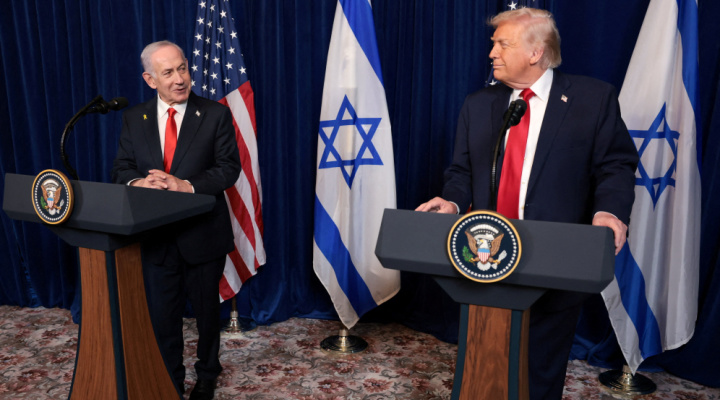
US President Donald Trump and Israeli Prime Minister Benjamin Netanyahu hold a press conference after meeting at Trump’s Mar-a-Lago club in Palm Beach, Florida, US, Dec. 29, 2025. Photo: REUTERS/Jonathan Ernst
The Washington Free Beacon has just released data from a June survey of likely Republican primary voters which show continued strong support for the decades-long relationship between the United States and Israel.
The survey found a Republican primary base that remains firmly pro-Israel. Primary voters preferred a pro-Israel candidate over an anti-Israel one by fifty-seven points and favored candidates who explicitly denounced antisemitism by fifty-two points. The Free Beacon reports that these primary voters “were less likely to support a candidate who describes Israeli prime minister Benjamin Netanyahu as a war criminal, who takes steps to economically isolate Israel, and who votes against congressional resolutions denouncing antisemitism — by margins of 25 points, 43 points, and 43 points respectively.”
While this may be welcome news to those who support Israel— especially given the open hostility harbored by the Democratic Socialists of America and those on the left who have celebrated everything from Zohran Mamdani’s win in New York to a string of DSA-backed primary victories around the country— it is dangerous to believe that Republicans in general will remain such staunch supporters of Israel going forward.
I say this because the Free Beacon survey tells us where Republican primary voters stand now, but they’re only one part of the Republican coalition and an even smaller slice of the country.
Those respondents in the Free Beacon sample are the Republican activists of today who volunteer, donate, and reliably turn out in low-turnout primaries and, as such, choose the party’s nominees now,
Outside of this electorally powerful primary sample, however, the picture of the electorate looks different. A recent Pew Research Center survey found that while four in five Democrats now view Israel unfavorably, a majority of Republicans (57 percent) under fifty do as well. The same Pew survey also found that 60 percent of Americans now view Israel unfavorably, up from 53 percent just a year ago and nearly twenty points since 2022. Gallup likewise found Republican sympathy for Israelis has fallen ten points since 2024.
It would be unwise to overlook the fact that younger Republicans are not as supportive of Israel as their older counterparts, and that these younger Republicans have come of age in a media environment very different from the one that shaped their parents—one in which anti-Israel voices such as Nick Fuentes, Tucker Carlson, and Candace Owens command enormous audiences on the right.
Here, though, there is some encouraging news. Earlier Free Beacon polling of politically engaged young conservatives found strong support for President Trump’s handling of the U.S.-Israel relationship, and it found that regularly consuming content from those anti-Israel figures did not significantly change their views. Of course, politically engaged young conservatives are not the same thing as Republicans under fifty more broadly. However, these young conservatives will matter tremendously for they will eventually become the Republican primary electorate and agenda setters.
The Jewish community should not mistake persuasion for generational replacement. As political scientists Paul Abramson and Ronald Inglehart observed decades ago, public opinion often changes less because people change their minds than because one generation replaces another. Support for Israel is no exception and younger Republicans are not on the same page as their elders.
I’ve made a similar point about Democratic primaries. Zohran Mamdani did not persuade most Democrats to abandon Israel; he won because a highly organized minority turned out while most eligible Democrats stayed home. Republican primaries currently tell a different story. The primary electorate has held firm even as opinion outside it has become unsettled. But there is no law of politics that says it must stay that way.
That leads to three lessons for the Jewish community.
First, watch the primaries–a key lesson from political science. Mamdani and other DSA-backed candidates didn’t win because they persuaded a majority of voters. They won because they understood where power actually lies and the fact that low-turnout primaries often determine who eventually governs.
Second, don’t assume younger Republicans will simply inherit their parents’ views. Republican support for Israel was built over decades by families, synagogues and churches, schools, campus organizations, and political leaders. That work has to be done again for every generation and the import of the American- Israel relationship must be re-learned and re-affirmed.
Finally, treat today’s alliances as achievements rather than permanent facts. The partnership among American Jews, evangelical Christians, foreign-policy conservatives, and Republican elected officials took decades to build. As Adonis Hoffman recently argued, relationships built over decades still have to be maintained; they do not simply sustain themselves.
The Free Beacon poll is genuinely good news, but it is a snapshot of the Republicans who show up today, not a promise about the Republicans who are coming of age now and will be in power soon enough. Whether a poll taken ten years from now looks anything like this one will depend on whether the work that produced these numbers is taken up again.
Samuel J. Abrams is a professor of politics at Sarah Lawrence College and a senior fellow at the American Enterprise Institute.