






Jewish Advocacy Group Blasts Australian Higher Education Establishment Over Antisemitism Revelations

 by Dion J. Pierre


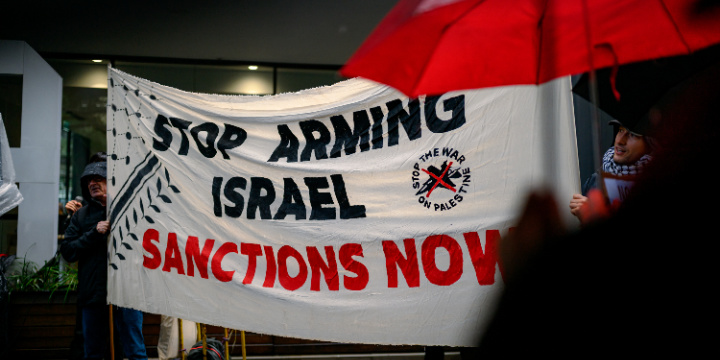
People protest against the Royal Commission on Antisemitism and Social Cohesion in Sydney, Thursday, July 9, 2026. Photo: AAP Image/George Chan via Reuters Connect.
Australian Jewish advocacy groups have condemned the country’s universities after Jewish students, staff, and vice-chancellors delivered damning testimony this week to the Royal Commission on Antisemitism and Social Cohesion, describing how campus leaders allowed anti-Israel activism and antisemitism to go largely unchecked, particularly after the Oct. 7, 2023, Hamas attack on Israel.
“The harrowing testimony of Jewish students and staff, together with the evidence of several university vice-chancellors, has laid bare systematic failures of university leadership that allowed antisemitism to flourish almost unchecked on campus, especially after the October 7th attacks by Hamas,” the Australia/Israel and Jewish Affairs Council (AIJAC) said in a statement on Wednesday.
The Royal Commission, led by former High Court Justice Virginia Bell, is holding a week of hearings in Melbourne, from July 13 to 17, focused on antisemitism at Australian universities. It has heard from Jewish students and academics about their experiences, as well as from vice-chancellors of institutions including the universities of Sydney, Melbourne, and New South Wales, over their handling of campus protests.
University of Sydney Vice-Chancellor Mark Scott appeared before the commission on Wednesday and apologized to Jewish students and staff for the university’s handling of a pro-Palestinian encampment that occupied its Camperdown campus between April and June 2024. Scott told the inquiry he had “learnt just how menacing and threatening many found the encampments.”
The council also criticized universities’ inaction over the encampments and the presence on some campuses of Hizb ut-Tahrir, an Islamist group that Australia listed as a prohibited hate group in early 2026 following the Bondi Beach attack. “Evidence regarding inaction over the extremist pro-Palestinian encampments and the presence of the now proscribed hate group Hizb ut-Tahrir on some campuses raises serious questions about the judgement and leadership shown at those universities at a time when Jewish students and staff were pleading for protection,” AIJAC said.
The group said the hearings should mark a turning point for the sector. “These hearings should be a watershed moment,” it said. “Australian universities should finally accept responsibility and accountability for their failures and commit to the meaningful reforms … necessary to restore the safety, confidence and trust of Jewish students and staff.”
The Royal Commission was established in January by the federal government after the Dec. 14, 2025, Bondi Beach attack, in which a father and son, Sajid and Naveed Akram, opened fire on a Hanukkah celebration attended by around 1,000 people, killing 15 and wounding more than 40. Authorities described it as an antisemitic, Islamic State–inspired terrorist attack — the deadliest terrorist incident in Australia’s history.
Antisemitic incidents across Australia surged after the Oct. 7, 2023, Hamas attack. The Executive Council of Australian Jewry (ECAJ), the main representative body of the country’s Jewish community, recorded a 316 percent rise in reported antisemitic incidents in the 12 months that followed, compared with the prior year.
The unrest included a protest outside the Sydney Opera House on Oct. 9, 2023 — two days after the Hamas attack — where demonstrators lit flares and chanted antisemitic slogans. Widely circulated footage claimed the crowd chanted “gas the Jews,” though a New South Wales police forensic investigation later concluded the words were “where’s the Jews,” a phrase Jewish leaders condemned as menacing regardless.
The Australian government this week imposed new anti-racism standards requiring universities to adopt a formal definition of antisemitism, establish transparent complaints processes, and better protect students and staff. The government stopped short of mandating any specific definition, including the widely used International Holocaust Remembrance Alliance (IHRA) definition — a decision the opposition criticized.
“There is no place for antisemitism or any type of hate in our universities or anywhere else,” Education Minister Jason Clare said in announcing the standards. “Unis will have to act to prevent racism and respond when it happens.”
Follow Dion J. Pierre @DionJPierre.


