





Antisemitic AI Videos Target Children With Disney-Pixar Style to Push Holocaust Denial, Report Shows
Error: Contact form not found.

 by David Michael Swindle

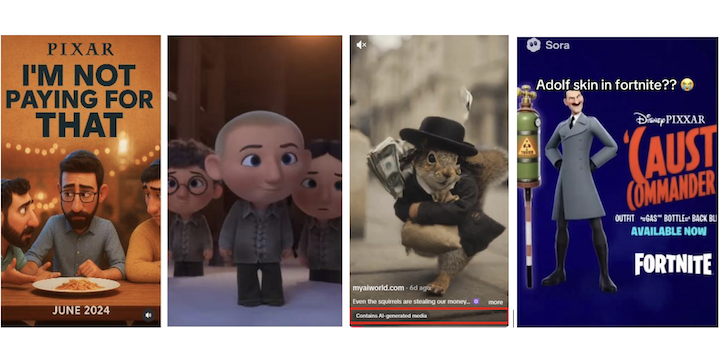
AI-generated videos found on TikTok, Meta, YouTube, and X imitated popular animation styles from Disney-Pixar movies to present Holocaust denial and antisemitic tropes to children. The image of a child second from the left is from a trailer depicting Jewish children in a concentration camp during World War II. Photos: Screenshot collage from CyberWell report.
A pathbreaking report released this week reveals that online users have started exploiting AI video generators to weaponize the nostalgia of Disney-Pixar styles, wrapping venomous hate in a candy-coated shell to reach youth.
On Sunday, CyberWell, a Tel Aviv-based nonprofit focused on monitoring antisemitism on social media, published research tracking 307 identified pieces of AI-generated content targeting Jews on social media between January 2025 and February 2026. The group found that the images and videos received 30 million views and more than 2.8 million user interactions such as likes or reshares. They observed animations created with OpenAI’s Sora, Google’s Veo, X’s Grok, and Suno.
While TikTok accounted for the biggest chunk of the content at almost 36 percent, the popular video-sharing service also came through with the highest level of enforcement at more than 88 percent. Instagram drove the top rates of engagement, accounting for almost 65 percent while its total antisemitic posts reached nearly 25 percent.
The Meta platform saw a removal rate of 67 percent, notably higher than Alphabet’s YouTube (28 percent) and billionaire Elon Musk’s X platform (20 percent). Musk recently incorporated X, xAI, and its Grok chatbot into his rocket company SpaceX before an anticipated IPO in June.
CyberWell found three primary narratives across the videos: 33.2 percent portrayed Jews as greedy or money-obsessed, 21.5 percent involved the Holocaust, and 21.2 percent presented violent rhetoric against Jews inspired by a specific event, in this case the June 2025 Israel-Iran conflict and the viral video “Boom, Boom, Tel Aviv.” The video features such lyrics as “Boom, boom, Tel Aviv. This is what you get for all your evil deeds […] You brought this upon yourself, it’s your time to bleed […] Humanity never expected good behavior from you Jews.”
The researchers called mid-2025 a turning point in the rise of AI-driven antisemitic videos, with 98.4 percent of identified content originating from that point forward.
The report describes “a recurring pattern in which users package AI-generated antisemitic content in formats designed to appeal to younger audiences. The most common examples include fabricated Disney-Pixar-style movie trailers and gaming-related audio clips that promote Holocaust-related mockery, antisemitic conspiracy theories, and hate speech targeting Jews.”
One of the techniques users attempt to evade moderation is to label such videos with tags claiming “satire” and “dark humor.” Others will use the term “Caust” instead of “Holocaust.”
One example presented features a fabricated trailer for a “Caust” movie created with Sora in the Pixar style. Researchers described how “set in a concentration camp, the trailer portrays Adolf Hitler in a lighthearted manner while following a group of Jewish child prisoners attempting a dramatic escape. By presenting the Holocaust in a playful, animated format, the video turns atrocity into entertainment and diminishes the gravity of Jewish suffering.”
The AI videos also exploit kids’ love for video games.
One TikTok video created with Sora and titled “CAUST COMMANDER” received 66,500 views, 4,623 likes, and 3,619 reposts. According to the report, “the post portrays Adolf Hitler in a playful, stylized manner while depicting him killing those around him. The video makes light of the Holocaust and the mechanisms used to exterminate Jews by presenting them in a gamified, commercialized format, including the promotion of fake merchandise such as Zyklon B gas, themed outfits, and ‘back bling.'”
On March 24, OpenAI announced the decision to shut down Sora following months of reporting on antisemitic content proliferating across the platform. Analysts judged that the decision was reportedly motivated by a need to free up computational power for the training of new models so OpenAI could remain competitive as Anthropic’s Claude surges in popularity among coders and Alphabet’s Gemini draws away users.
The report emphasizes the deep extent to which antisemitism has penetrated AI systems.
“Many of the websites used in AI training datasets function as active hubs for antisemitic discourse, raising concerns about their inclusion in model development,” the report says. “For example, Reddit ranks among the most cited domains across major AI systems, while analyses of ChatGPT outputs indicate that Wikipedia alone contributes to roughly half of generated responses. The reliance of AI companies on these websites underscores the risk that antisemitic narratives circulating online may become embedded in model inputs and later disseminated at scale.”
CyberWell CEO and founder Tal-Or Cohen Montemayor warned that AI had turbo-charged both the speed and intensity of online antisemitism.
“Artificial intelligence has fundamentally changed the scale and speed at which antisemitism can be produced and distributed online,” Cohen Montemayor said. “Generative AI now allows bad actors to industrialize hate, producing high-impact content that can reach millions, with enforcement often coming only after it has already been widely amplified.”
Cohen Montemayor added that CyberWell’s latest report “examining the circulation of antisemitic AI-generated content on major platforms provides critical insights for how social media platforms can take on the abuse of generative AI tools to spread antisemitism in the digital universe.”
CyberWell found that while the Pixar-fied, disarming aesthetics targeted children, it was the videos openly glorifying violence that provoked the highest level of shares reaching 33 percent of content but 41 percent of engagement.
Cohen Montemayor called for the platforms to “move beyond disclosure and invest in systems that identify harmful narratives at scale, including those embedded in audio, visuals and coded formats that evade traditional detection.”
Warning that AI was “being weaponized at scale,” Cohen Montemayor explained that “by strengthening automated detection, investing in competent and transparent human moderation, auditing training data and partnering with specialized external stakeholders, platforms and AI developers can address the complex and fast-evolving forms of online hate through sustained collaboration between technology companies, policymakers and expert partners.”
In one of the most closely watched legal battles in artificial intelligence, a jury on Monday ruled against Musk in a lawsuit the billionaire filed to force OpenAI to revert fully to its original nonprofit mission. Jurors decided that Musk had filed his suit too late.
The world’s wealthiest man faces potentially more severe legal challenges in response to his AI business in France, where prosecutors said they intended to pursue criminal charges due to the Grok chatbot’s promotion of Holocaust denial and generation of child sexual abuse images.


